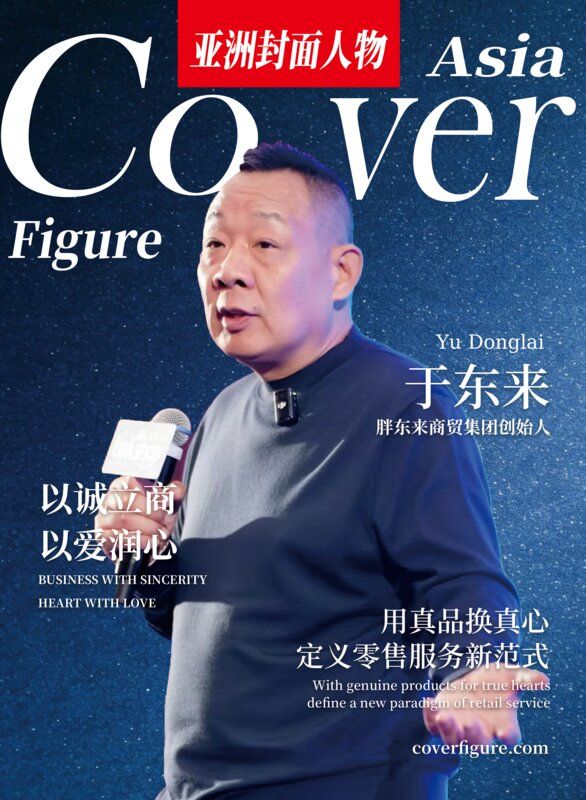
Yu Donglai, the founder of Pang Donglai Trading Group, has created a business miracle known as the "Chinese retail industry myth" with his ultimate service and employee care concepts.
Yu Donglai
Asian Cover Figure | Yu Donglai: From Xuchang's Streets to China's Retail Spiritual Highland
Asian "Cover Figure" Magazine · The Business Contrarian
Issue No. 010-
At a time when China's retail industry continues to undergo structural adjustment, a local supermarket rooted in Xuchang, Henan Province has consistently won consumer trust and industry respect through an approach that is almost "anti-business-common-sense." Its name is Pangdonglai (Fat Donglai). And the person who created this retail model is Yu Donglai.
Yu Donglai, founder of Pangdonglai Commercial Group. He has no prestigious business background, no overseas education, and no strong capital market backing. Starting from a tobacco and liquor shop on Xuchang's streets, he spent over thirty years transforming a local retail enterprise into what the industry widely studies as the "Pangdonglai phenomenon." In an environment where e-commerce encroaches and physical retail faces widespread pressure, Pangdonglai has maintained steady operations and extremely high customer satisfaction, becoming one of the rare long-term positive cases in China's physical retail sector.
I. Grassroots Beginnings: From a Humble Shop to the Formation of Retail Beliefs
Yu Donglai was born in Xuchang, Henan. His family was ordinary in his youth, and he entered society early to make a living. He ran small businesses, set up street stalls, sold miscellaneous goods, and experienced multiple entrepreneurial failures. These grassroots experiences gave him an authentic understanding of ordinary consumers' needs and shaped his core business philosophy of "treating people with sincerity, exchanging heart for heart."
Around 1995, Yu Donglai opened a modest-sized "Pangdonglai" store in Xuchang. The name was simple, the meaning straightforward — hoping to do business honestly and prosperously. At that time, the retail industry was still in a rough stage, with goods of uncertain authenticity and inconsistent service. From the start, Yu insisted on genuine products, transparent pricing, and hassle-free returns. These practices, now considered basic business standards, were remarkably distinctive in county-level markets of that era.
Early entrepreneurship was not smooth. According to public reports, Yu Donglai suffered fires, operational difficulties, and multiple setbacks, but never lowered his standards for quality and integrity. It was precisely this experience of climbing step by step from the bottom that made him deeply recognize: retail's essence is not simple buying and selling, but a long-term process of building trust.
II. Service Philosophy: Writing "Respect for People" into the Business Model
The reason Pangdonglai attracts industry attention is not its scale or capital operations, but that it has taken "service" to a depth that exceeds industry expectations.
Walking into a Pangdonglai store, customers experience numerous attentive service details: complimentary water and rest areas, product information clearly labeling origins, proactive assistance carrying heavy items, disposable rain gear prepared for customers on rainy days. When customers are dissatisfied with products, Pangdonglai's return process is extremely simplified with virtually no barriers. These details don't come from standardized service manual training, but from the philosophy Yu Donglai repeatedly communicates to his team — "Being good to customers isn't a strategy; it's instinct."
What draws even more industry attention is Pangdonglai's attitude toward employees. In the labor-intensive retail industry, Pangdonglai has long maintained salary levels above industry average, providing employees with comprehensive rest areas, training systems, and welfare benefits. Yu Donglai once stated publicly that an enterprise doesn't belong to the boss alone; employees are not tools but partners who grow together. He returns substantial profits to employees through bonuses, benefits, and vacation time, enabling them to work with dignity and have the energy to serve customers well.
This "first be good to employees, then employees are good to customers" business logic constitutes the foundational architecture of Pangdonglai's unique service system. It is not a simple management technique, but a value system that puts "people" at the center of the business model.
III. Growing Against the Tide: The "Pangdonglai Phenomenon" in an Industry Winter
Over the past decade-plus, China's physical retail has experienced unprecedented impact. E-commerce's rise, changing consumer habits, rising rents and labor costs — massive numbers of traditional supermarkets faced a wave of closures. In this great industry reshuffling, Pangdonglai not only didn't contract but maintained stable foot traffic and sales growth, even attracting consumers who travel cross-city specifically to "check in" and shop.
This phenomenon attracted widespread industry attention. Multiple business researchers and industry analysts traveled to Xuchang for field investigations, deconstructing Pangdonglai's business model into multiple dimensions: ultimate service experience, highly standardized merchandise management, a positive cycle driven by employee satisfaction leading to customer satisfaction, and the strategic restraint of rooting in regional markets without blind expansion.
Yu Donglai has always maintained caution about expansion. In his view, a retail enterprise's core capability is service quality, not store count. Pangdonglai's stores are concentrated mainly in Xuchang and surrounding areas. This "cultivating locally" strategy allows the company to concentrate resources on improving single-store operational quality rather than chasing scale numbers. This restraint and focus are precisely the keys to Pangdonglai's stable growth during industry adjustment periods.
IV. The Enlightenment of Business Civilization: Returning to Retail's Source Value
The story of Yu Donglai and Pangdonglai provides a thought-provoking reference frame for China's business community. In a business environment pursuing scale, speed, and capital returns, Pangdonglai chose a different path: not pursuing IPO financing, not engaging in aggressive nationwide expansion, not compressing costs for short-term profit — instead focusing energy on improving employee happiness and customer experience.
This approach seems "anti-efficiency," yet it has harvested extremely high customer loyalty and employee stability. Pangdonglai's employee turnover rate is far below industry average, customer repurchase rates remain consistently high, and store per-square-meter performance is excellent. These metrics demonstrate that "people-oriented" is not an empty slogan but a business logic that can translate into tangible operational results.
Yu Donglai has also opened Pangdonglai's business philosophy to more peers through public sharing and industry exchanges. He has candidly stated at industry forums that retail holds no profound secrets — the core is simply "treating people with sincerity" — sincere to customers, sincere to employees, sincere to suppliers. This simple yet firm business philosophy has become increasingly precious in an ever more complex business world.
V. The Contrarian's Vision: Guarding Warmth in an Efficiency-First Era
Yu Donglai is not a "business hero" in the traditional sense. He hasn't changed the industry's technological landscape, created an entirely new business model, or built a thousand-billion-dollar capital legend. What he has done is simple — in an ordinary inland city, over thirty-plus years, earnestly running a supermarket, treating every employee well, sincerely serving every customer.
But it is precisely this simplicity that constitutes Pangdonglai's deepest strength. In a business world pursuing speed, Yu Donglai chose to slow down, doing fundamental things to the extreme. He proved through action: business's ultimate purpose is not chasing numbers but creating value; retail's core competitiveness is not price wars but trust.
From a humble shop on Xuchang's streets to a "retail model" studied by the national business community — the story of Yu Donglai and Pangdonglai is a warm yet powerful footnote in China's business civilization progress. It reminds every practitioner: in any era, sincerity and goodwill remain the most solid business moat.