Visionary Leaders
They measure the business empire from the commanding heights of the era.
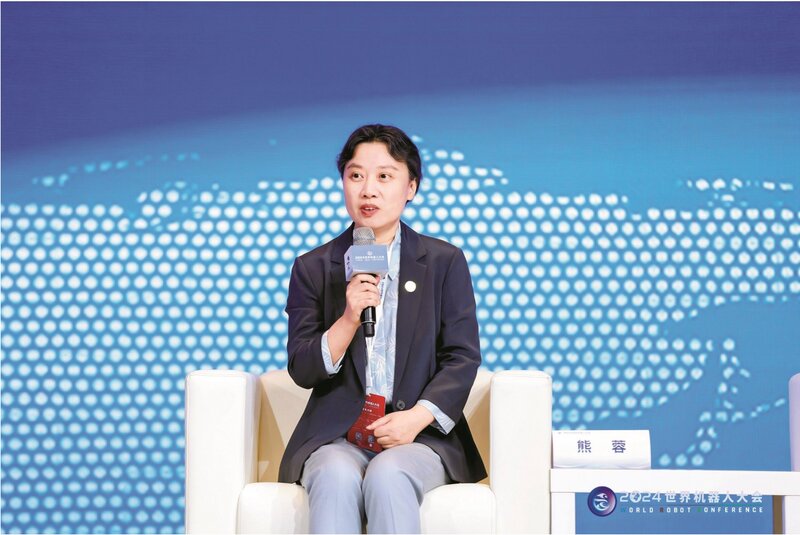
Xiong Rong
“Embodied intelligence is the next frontier of AI, which requires robots to truly understand the physical world.”
From computer science master to robotics expert, from laboratory researcher to IPO founder. Xiong Rong spent 25 years proving that the real value of technology is not in papers, but in factories. In March 2026, the International Federation of Robotics (IFR) announced the list of winners for "Women Shaping the Future of Robots". Only 11 people in the world have won this award, and Xiong Rong is the only winner from China this year. In the public eye, her name is not high frequency. But in the field of domestic robots, her research and industrial practice have run through the complete cycle of the industry from blank to rising, and she has been involved in it for 26 years. In 2000, she knew next to nothing about the field of robotics. In 2026, the industrial robot company she co-founded officially submitted a prospectus to the Hong Kong Stock Exchange, with a corporate valuation of 2.13 billion yuan. Over the past twenty years, Xiong Rong has been doing one thing: steadily planting the technological seeds in the laboratory into real industrial soil. 1. Sowing seeds: the "zero starting point" from computers to robots. In 1990, Xiong Rong was admitted to the Computer Science Department of Zhejiang University and studied computer theory systems. Compared with abstract classroom theoretical deductions, she is better at practical implementation. She prefers hands-on verification and practical exploration learning methods, and can accumulate cognition and accumulate abilities in concrete practice. In 1997, Xiong Rong, who graduated with a master's degree, chose to stay at the school and served as a school laboratory technician. She was responsible for basic work such as laboratory mailbox management and server maintenance on a daily basis. The work content was stable and routine and had nothing to do with cutting-edge scientific innovation and intelligent technology. At that time, she had not yet interacted with the field of robotics. 2
Xiong Rong
ACF Cover Figure | Xiong Rong: From Lab Technician to Robot Pioneer — Planting Seeds That Grew into a Forest
Asia "Cover Figure" · Perspective
In the annals of China's robotics development, Xiong Rong stands as a unique figure — a female scientist who went from managing email servers to leading robots that defeated Carnegie Mellon three times, from pure researcher to founder of a company valued at over 2 billion RMB. Her 26-year journey is not a legend of counterattack, but a story of daily cultivation, industrial application, and talent cultivation.
I. Seed: From Email Server to Football Robots
In 1990, Xiong Rong entered Zhejiang University's Computer Science department. Unlike many students who excel in theoretical study, she has always believed that knowledge must be verified through hands-on practice. "I'm probably not strong in abstract thinking, so classroom learning doesn't give me much feeling. I prefer learning by doing."
In 1997, after completing her master's degree, Xiong Rong chose to stay at the university as a lab technician, managing email systems and maintaining servers — stable, routine work with no connection to frontier innovation. At that point, robotics had not yet entered her world.
In 2000, a chance opportunity changed her research direction. Lab director Chu Jian asked if she'd take on a football robot research project. Facing a completely unfamiliar field with virtually nothing in China, Xiong Rong didn't hesitate. She admitted she didn't yet understand robot core principles or application logic — a complete industry novice.
To fill knowledge gaps, she traveled to Northeastern University to learn frontier experience. She simultaneously posted on ZJU's campus BBS recruiting members, assembling a 3-4 person team from scratch, beginning a journey of robotics research with zero foundation, all exploration.
She's no genius — she's a pragmatist who started from zero, learning by doing. That seed was planted in 2000.
II. Taking Root: RoboCup Triple Champion and Humanoid Robots
The team built basic football robot systems through exploration. But long competition practice revealed a core shortcoming: early robots were typical "brainless" systems, with all decisions, perception, and control heavily dependent on external computers — unable to operate autonomously.
Seeing this clearly, she decisively shifted research direction, breaking free from traditional competition robot limitations and deeply cultivating autonomous intelligent mobile technology, focusing on SLAM core technology — returning environment perception, path planning, and autonomous decision-making authority to the robot itself.
During humanoid robot development, faced with slow model progress and frequent technical difficulties, team students often grew anxious. Xiong Rong maintained a pragmatic, determined mindset: "It's fine to set ambitious goals. Eat one bite at a time, walk one step at a time."
Steady technical advancement yielded rich results. In 2013, 2014, and 2018, Xiong Rong led ZJU's ZJUDancer team to defeat the world's top Carnegie Mellon University team three times, winning the RoboCup Robot World Cup small-size league championship, successfully defending in 2019, establishing firm position in the global first tier.
She continued expanding R&D boundaries, successively developing table tennis humanoid robots and quadruped running-jumping robots, breaking through multiple core bottlenecks and filling domestic technology gaps.
Competition championships are the first leaves of technology taking root. From "brainless" to "autonomous" — she taught robots to think.
III. Breaking Ground: IPLUS Technology's Darkest Hour and Comeback
After 12 years of deep lab cultivation, Xiong Rong focused on technical breakthroughs. In 2012, Huawei, ABB, and other industry leaders approached for collaboration. Real industrial needs and pain points made her deeply aware of the significance of research landing in practice — and the enormous gap between lab technology and industrial application.
Technology can only achieve true value when it lands in industry and solves real problems. In 2016, Xiong Rong formally founded IPLUS Technology (Jiazhi Technology), focusing on the industrial mobile robot (AMR) track.
The early-stage market was far harder than R&D. The domestic AMR track was in its infancy — weak market awareness, blank application scenarios, missing industry standards. For three full years, IPLUS not only refined products but shouldered market education. The team visited manufacturing factories nationwide, patiently explaining AMR value, slowly opening market space.
"Research seeks technical breakthroughs; running a enterprise means making money." She was clear-eyed about the transition. From researcher to entrepreneur is a completely different logic system. From 2023 to September 2025, the enterprise accumulated 304 million RMB in losses — the cost of technology meeting production-line reality.
Long cultivation finally yielded industrial breakthroughs. With 0.03mm ultra-high precision operation and mature large-scale fleet scheduling technology, IPLUS built formidable technical barriers, winning investment from ByteDance, Lenovo Capital, Shenzhen Capital Group, and others, reaching a valuation of 2.13 billion RMB. Revenue: 74.95 million (2023), 115 million (2024), 201 million (Jan-Sep 2025). In January 2026, IPLUS formally submitted its prospectus to HKEX.
She planted her roots from the lab into the factory. Losses aren't failure — they're the price of taking root. From scientist to CEO, her tuition was 304 million.
IV. New Branches: A Pragmatic Path for Humanoid Robots
After establishing a firm position in industrial AMR, Xiong Rong continued expanding frontiers. In late 2023, she led the creation of Zhejiang Humanoid Robot Innovation Center. While most teams chase bipedal walking and high-simulation form factors, Xiong Rong maintained a pragmatic approach: "wheeled base + humanoid upper body" architecture, prioritizing real industrial scenarios over concept innovation.
In January 2026, the center completed a 450 million RMB Pre-A round (cumulative financing 2.2 billion), bringing in China Merchants Group Innovation & Technology and other industrial capital. The team successfully achieved technology export, delivering a dedicated refrigerator production line inspection robot for Turkish appliance giant BEKO — the first benchmark case of Chinese humanoid robot technology going overseas.
When the trend arrives, she's already in it. Not chasing wind — planting it.
V. Forest: The Seeds She Planted
Over 26 years in robotics, Xiong Rong is not only a research pioneer and industrial entrepreneur but a talent cultivator. In 2001, she established ZJU's Robot Science Education Practice Base. Her students now lead major companies: Zhu Qiuguo founded Deep Robotics (among Hangzhou's "Six Little Dragons"); Chen Shouxian serves as IPLUS CEO; Wang Shiquan founded Flexiv, focusing on flexible robotics.
Generation after generation of young entrepreneurs and researchers have emerged from her classroom and lab, each deepening in their robotics niche, forming a vibrant new force in domestic robotics.
"Robotics and engineering should not be limited by gender. Persistence and passion matter far more than gender differences."
The seeds she planted grew into a forest. True achievement isn't standing on the summit yourself — it's helping many others stand there.
Follow


Scan to follow for more stories
Cover ArchiveArchive
View archive file →Every cover publication is registered and kept in the ACF Cover Archive. The code is permanent.


Not Everyone Makes the Cover
Asia Cover Figure · Influencing Those Who Influence