Visionary Leaders
They measure the business empire from the commanding heights of the era.
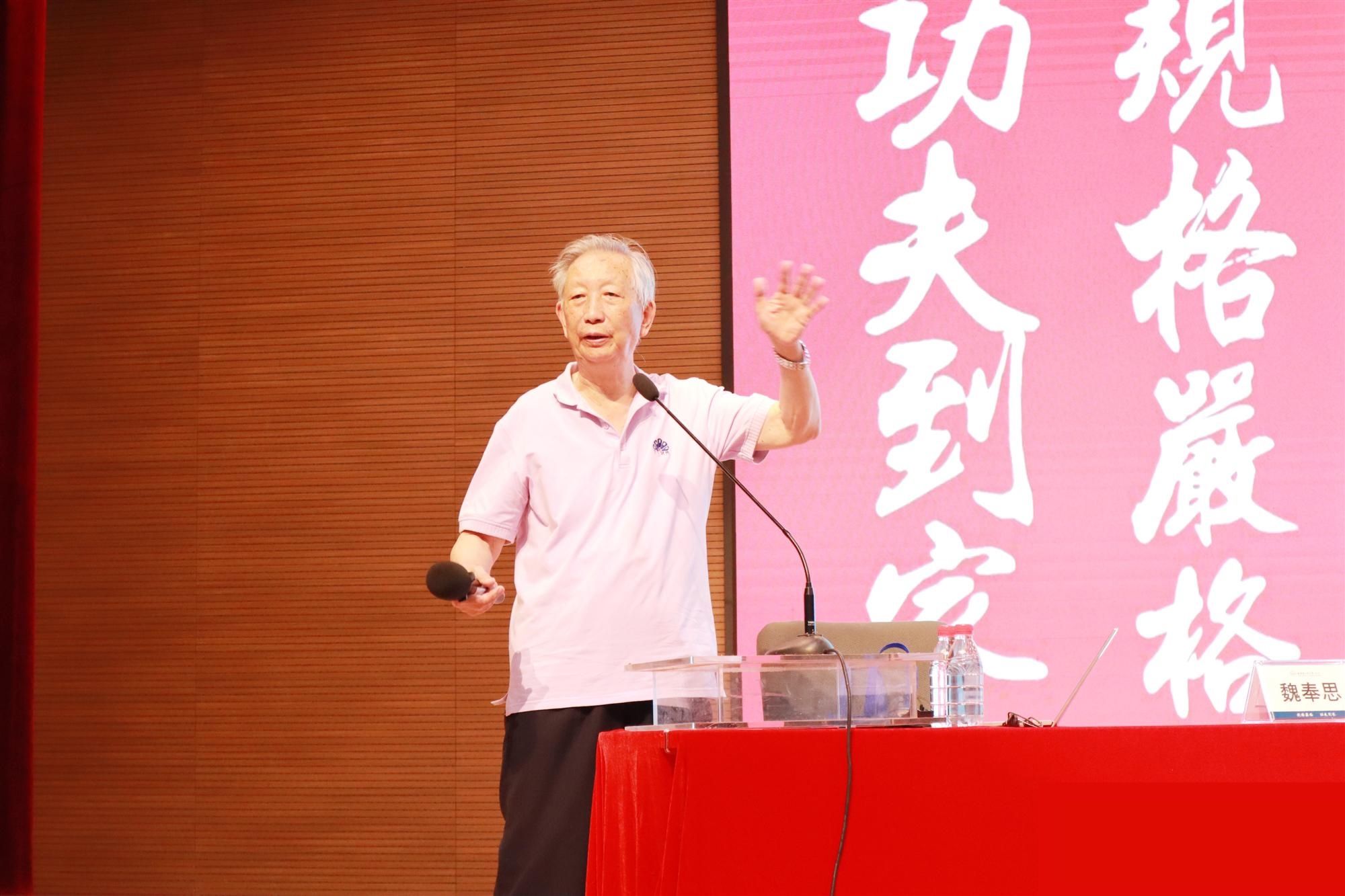
Wei Fengsi
“Space weather is related to national security, and basic research must be guarded.”
At 85 years old, he is still working. Carrying an old canvas bag, he does the job of "doing CT scans for space". From the conception of the project in 1993 to the completion of the first phase in 2012, it took him 19 years. At the age of 75, he embarked on a new journey in the "digital space". Wei Fengsi: If scientists don’t even dare to dream, how can they achieve great things? At the age of 85, Wei Fengsi walks to the office every day, carrying an old canvas bag that his daughter has discarded. He has long been engaged in a research field that is somewhat obscure to the public - space weather. To use his popular expression, this career is “doing CT scans for space.” Faced with questions from the outside world about still sticking to his post at an advanced age, he has always been firm. "Scientists don't even dare to dream, how can they achieve great things?" 1. Seed: From trackers to space In 1941, Wei Fengsi was born on the Fujiang River in Mianyang, Sichuan. When he was a boy, he saw with his own eyes the trackers on the river jumping into the freezing cold water to pull boats in the dead of winter, struggling to make a living in a difficult environment. The hardships of the people at the bottom are deeply imprinted in his memory of growing up. At that time, he had a simple ideal buried deep in his heart, and he must rely on what he had learned to improve the living conditions of ordinary people. In middle school, his dream was to become a mechanical engineer and develop tools to reduce the labor burden of farmers. In 1958, Wei Fengsi took the college entrance examination and applied for the automation major as his first choice, and was eventually assigned to the Department of Geophysics. In the same year, the call "We also want to build artificial satellites" resounded throughout the country, and the University of Science and Technology of China established the Department of Geophysics. The tide of the times and personal choice converge here, and he welcomes
Wei Fengsi
ACF Cover Figure | Wei Fengsi: At 85, He's Still Giving Space a CT Scan
Asia "Cover Figure" · Perspective
Issue No. 054 — ACF-2026
[Summary] At 85, he still goes to work every day, carrying an old canvas bag, doing the work of "giving space a CT scan." From proposing the concept in 1993 to completing Phase I in 2012 — it took 19 years. At 75, he launched a new "Digital Space" journey. Wei Fengsi: "If a scientist doesn't even dare to dream, how can he accomplish anything great?"
At 85, Wei Fengsi walks to the office daily, carrying an old canvas bag his daughter discarded.
His long-cultivated research field sounds obscure to the public — space weather. In his own accessible terms, this work is "giving space a CT scan."
When asked about his persistence at advanced age, his stance remains resolute:
"If a scientist doesn't even dare to dream, how can he accomplish anything great?"
I. Seed: From Tracker to Outer Space
Born in 1941 by the Fujiang River in Mianyang, Sichuan, Wei Fengsi as a boy witnessed riverside trackers plunging into freezing winter waters, bending their bodies to pull boats, scraping by in harsh conditions. The hardship of ordinary people was deeply imprinted on his growing memory.
A simple ideal took root: he must use his learning to improve ordinary people's lives. In middle school, his dream was to become a mechanical engineer, developing tools to ease farmers' labor.
In 1958, Wei Fengsi took the college entrance exam, listing automation as his first choice — but was assigned to the geophysics department. That same year, the call "We too must develop satellites" rang across China, and USTC established its geophysics department. The tides of the era met personal choice, bringing a crucial turning point.
He studied under Academician Zhao Jiuzhang, the "Father of Chinese Satellites." Under this master's guidance, his personal vision shifted from terrestrial mechanical engineering to the vast expanse of space.
Looking back at his youthful aspiration, Wei Fengsi is direct: "I had to do something so ordinary people wouldn't suffer like this anymore."
His starting point was a Fujiang River tracker's son. His destination was the stars and sea. A tracker's son decided to give space a CT scan.
II. Concept: The "Wild Dream" of Scanning Space
In the 1990s, international mainstream space weather monitoring universally adopted the technical route of first launching satellites, then building ground monitoring facilities. The industry path was already fixed.
In 1993, Wei Fengsi proposed a groundbreaking concept: along the 120°E meridian, build a nationwide ground-based space environment monitoring network, named the "Meridian Chain." He went against the grain, choosing to first lay the ground monitoring network, precisely mapping space environment patterns before advancing further — forging an independent path different from foreign approaches.
Once proposed, doubts poured in. To the industry, the project's enormous scope, cross-regional coordination difficulty, and massive funding requirements made it seem nearly delusional. Peers generally disfavored this non-mainstream technical route.
In 1997, the Meridian Project was formally listed as a National Major Science Project. After approval, rather than rapid implementation, it entered a decade-plus period of quiet. The long wait and uncertainty caused many peers to leave.
Facing others' dissuasion and wavering, Wei Fengsi remained certain: "Don't try to persuade me. We chose this road ourselves, so we'll stay right here and keep at it, steadily."
Others launch satellites first; he laid ground infrastructure first. Going against the current takes conviction. A wild dream? From concept to completion took 19 years.
III. Perseverance: 19 Years — A "Space Great Wall"
From the 1993 Meridian Project concept to the 2008 Phase I groundbreaking to the 2012 Phase I national acceptance — Wei Fengsi devoted a full 19 years to this cause.
Phase I deployed 15 stations nationwide with 87 sets of professional monitoring equipment, initially building a space environment ground monitoring network covering China's territory. Phase II progressed to deploy a cumulative 282 monitoring sets, creating the world's widest-coverage, most comprehensive-parameter, strongest-capability space environment ground monitoring network — dubbed the "Space Great Wall" safeguarding China's aerospace security.
In March 2025, Phase II of the Meridian Project passed national acceptance. This system, refined over decades, entered full stable operation, building a space environment safety barrier for satellite launches, space station operations, and aerospace missions.
Through those long 19 years — from a paper concept to a landed national major project — Wei Fengsi endured waiting, withstood doubt, held fast to his original aspiration, and completed a nearly impossible scientific research practice through prolonged perseverance.
19 years — he built a "Space Great Wall" that gives space a CT scan. Persistence isn't a saying — it's 19 years.
IV. New Departure: At 75, A New "Digital Space" Dream
In 2016, at 75, Wei Fengsi did not stop. Building on the Meridian Project's massive monitoring data, he proposed the "Digital Space" new strategic concept.
Leveraging big data and AI frontier technologies, he equipped the space weather monitoring system with a "smart brain," building a digitalized space environment system enabling precise prediction and intelligent early warning of space environment changes — pushing China's space weather research from monitoring and observation into intelligent prediction.
At an age when most choose to enjoy retirement, he proactively launched an entirely new research track. Many around him didn't understand. But in Wei Fengsi's eyes, national-strategy-level scientific work has no retirement date.
Over the years, he has persisted in delivering popular science lectures in space physics, averaging 40-50 sessions annually, always available on short notice, visiting campuses and reaching the public — spreading space physics knowledge, sowing seeds for young researchers, and cultivating industry talent.
On research choices, he holds clear values: "I don't advocate choosing short-term, fast-result, follow-and-imitate topics. If you're going to choose, choose things with long-term national impact that can serve the future."
The Meridian Project is not a period — it's a semicolon. At 75, he set out again.
V. Creed: Simplicity, Persistence, Service, Dreaming
Over decades of scientific career, Wei Fengsi distilled four life creeds: simplicity is happiness, persistence is faith, service is spirit, dreaming is responsibility.
In his scientific principles: research must maintain simplicity and purity, rejecting restlessness and opportunism, not chasing fame or shortcuts. Career requires lasting persistence, settling down on cold benches, unafraid of the long road ahead. Scholars must carry homeland in their hearts, anchoring personal research directions to national strategic needs. Scientists must dare to dream, breaking through fixed thinking, exploring where none have ventured before.
In an academic environment pursuing "short, fast, immediate" results, Wei Fengsi's creeds seem almost "classical."
"Simplicity" — means rejecting fame and shortcuts. "Persistence" — acceptance of the long cold bench. "Service" — anchoring personal passion to national needs. "Dreaming" — defending science's most primal imagination in an age of pragmatism.
These four simple sentences defined him — and reflect a scientist's character perhaps becoming scarce.
He has always lived by his creeds: "Simplicity is happiness, persistence is faith, service is spirit, dreaming is responsibility."
Research must be simple, career must persist, scholars must serve, and Chinese people must dare to dream. At 85, he still goes to work. Not because he can't retire — but because the dream isn't finished yet.
Follow


Scan to follow for more stories
Cover ArchiveArchive
View archive file →Every cover publication is registered and kept in the ACF Cover Archive. The code is permanent.



Not Everyone Makes the Cover
Asia Cover Figure · Influencing Those Who Influence