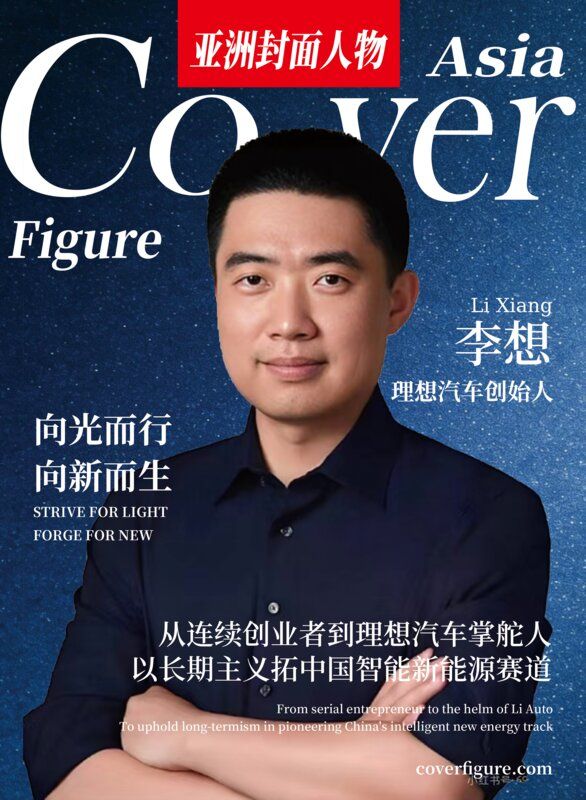
From an Internet entrepreneur who dropped out of high school, to the IPO leader of Autohome, to the founder of Li Auto, 45-year-old Li Xiang has written his own business journey through three entrepreneurial ventures. He started again from the desperate situation of zero career twice, built cross-border cars and faced the doubts of the entire Internet. He experienced ups and downs in the wave of the new energy track, and finally gained a foothold with pragmatic product concepts...
WeChat Official Account AsiaCoverFigure
ACF Cover Figure | Li Xiang: The 45-Year-Old Auto Pioneer — From Three Startups to Embodied Intelligence, Defining Family Mobility
"Cover Figure" is an international premium business figure media platform published by Asia Cover Figure Magazine, rooted in Asia with a global reach.
Asia "Cover Figure" · Perspective
Issue No. 029 — ACF-2026
From a high school dropout turned internet entrepreneur, to the helm of Autohome's IPO, to the founder of Li Auto — at 45, Li Xiang has written his own business saga through three entrepreneurial ventures. Twice he rose from the ashes of total loss, crossed into automobile manufacturing amid nationwide skepticism, weathered the storms of the new energy race, and ultimately gained a firm foothold with a pragmatic product philosophy — before decisively pivoting toward embodied intelligence. Along the way, jeers and applause have accompanied him, valleys and peaks intertwined, yet Li Xiang has pressed forward on the road of car-making with the courage to face failure head-on and an unwavering commitment to understanding users.
Young and Online: Dropping Out to Build a Business
Born in Shijiazhuang, Hebei in 1981, Li Xiang bonded with the internet early. At fifteen he discovered it; at sixteen he built his own website, updating content every morning at 4 a.m., steadily driving daily traffic into the tens of thousands — revealing an extreme dedication to entrepreneurship while still a teenager.
During his senior year of high school, faced with the choice between academics and business, Li Xiang resolutely abandoned the college entrance exam and set off on the entrepreneurial path with his first earnings. This was no impulsive rebellion, but a determined pursuit of his vision. By twenty-three, his Paopao Net (Pop Network) was generating nearly 20 million RMB in annual revenue, carving out a territory in the internet industry. At twenty-nine, he led Autohome to a successful listing on the New York Stock Exchange, with the company's market capitalization briefly exceeding 5 billion USD. Li Xiang stood at his first career peak, a rising star widely admired in the industry.
From Zero Again: Pawning Everything to Build Cars for Families
Just as life seemed boundless in promise, Li Xiang lost control of Autohome, forced out of the enterprise he had spent over a decade building. Everything appeared to reset to zero overnight. Those around him urged him to rest, but an inextinguishable fire within convinced him he could still do something even greater.
In 2015, Li Xiang made a decision that stunned the entire industry — he mortgaged all his personal assets to found Li Auto. At the time, the choice was met with universal incredulity: an internet veteran who had built websites, with no formal automotive training, dared to enter the technically forbidding world of car manufacturing. To outsiders, it was plainly a gamble with slim odds.
In the early stages, Li Auto quickly descended into its darkest hour. The company's cash flow nearly collapsed. Li Xiang's team persisted with range-extender technology, targeting users' range anxiety, yet drew widespread criticism — branded as backward and opportunistic. To raise funds, Li Xiang and his team visited over a hundred investment institutions, only to be rejected time and again. Company coffers held barely three months' worth of payroll — Li Xiang's closest brush with total failure.
Through countless sleepless nights, Li Xiang repeatedly questioned whether he had chosen the wrong path, yet an inner conviction never allowed him to surrender. He led his team into user communities, immersing themselves in real needs: the anxiety of charging on long trips, the inconveniences of traveling with family, the helplessness of waiting to charge in the cold. These granular pain points crystallized a core insight: what users wanted was never flashy features, but a safe, mobile home that could fit the whole family.
Having found the right direction, Li Xiang's team decisively cut all superfluous configurations, focusing on the six-seat SUV segment, pushing space, safety, comfort, and range to their extremes — all R&D and refinement revolving around Chinese families' mobility needs.
Li Auto ONE Breaks Through: IPO in Five Years, From Industry Doubt to NEV Mainstay
In 2019, the Li Auto ONE went on sale. With its precise family-mobility positioning and ultimate core experience, first-month sales immediately surpassed 10,000 units, shattering the record for domestically produced SUVs priced above 300,000 RMB — answering every doubter with hard market results. Capital that had once spurned Li Xiang now came knocking. Li Auto entered a new chapter.
In 2020, Li Xiang led Li Auto to a successful NASDAQ listing. From founding the company in 2015 to establishing itself in the NEV sector, Li Xiang needed only five years. In that span, he transformed from a widely doubted auto novice into a serious contender in the new energy arena — not through luck, but through deep user understanding and steadfast product conviction.
Repeated Blows: Reputation Through Storms, Holding Firm to Product Principles
The entrepreneurial road never grants permanent respite. Before the joy of reaching the summit had faded, trials came in rapid succession — Li Xiang faced the densest challenges of his career and the most intense public controversy.
In 2021, the Li Auto ONE was exposed for a mercury issue in its seats, thrusting Li Xiang into a public storm and sending the brand's reputation plunging. In 2022, shortly after the Li L9 launched, reports of broken axles during test drives triggered widespread debate; that same year, Li Xiang announced the discontinuation of the Li Auto ONE, sparking collective protests from existing owners. In 2024, as the NEV industry's price war erupted, Li Auto's sales came under pressure, spawning external concerns about the company's trajectory.
2025 became Li Xiang's hardest year in car-making. Store efficiency declined, product cycles came under strain, and Li Auto fell out of the top three among new-force brands in sales rankings. During that period, Li Xiang suffered sleepless night after sleepless night, yet never once considered giving up. In his view, all public doubt and market hardship ultimately had just one solution: make the product better.
To regain user trust, Li Auto offered lifetime warranty benefits to existing owners. To sharpen core competitiveness, the team raised vehicle safety standards by three levels. Amid intensifying industry competition, Li Xiang's team immersed themselves in autonomous driving R&D, seeking a breakthrough through technological strength.
Autonomous Driving Breakthrough: Strategic Upgrade from Smart Cars to Embodied Intelligence
After a period of consolidation, Li Auto reached a pivotal breakthrough in intelligent driving. On January 21, 2025, Li Auto launched the industry's first end-to-end urban NOA solution based on a single Horizon Robotics Journey 6M chip, entering mass production. With just 128 TOPS of computing power, the system covered urban, suburban, and even rural roads — a cost-effective, pragmatic approach that carved out a differentiated advantage in the autonomous driving space.
Before the 2026 Spring Festival, Li Auto pushed OTA 8.3, leveraging the VLA driver model's reinforcement learning to bring anthropomorphic driving to new heights, while simultaneously upgrading both the intelligent cockpit and intelligent powertrain systems — significantly enhancing the user experience. In a sector crowded with leading players, Li Auto forged its own distinctive path.
As of February 28, 2026, Li Auto's cumulative deliveries surpassed 1.5943 million units. Nationwide, 4,054 Li Auto super-charging stations were operational, with 22,447 charging piles — impressive results in both delivery and charging infrastructure.
Just as the industry assumed Li Auto would deepen its focus on intelligent vehicles, Li Xiang made another bold strategic move. In January 2026, he announced at an all-hands meeting: Li Auto would transform comprehensively from a smart car company into an embodied intelligence enterprise. The company would lay out foundational models, chips, embodied intelligence, and even humanoid robotics — with Li Xiang setting a clear target for his team: achieve Level 4 autonomous driving deployment no later than 2028.
Three Ventures, Two Resets to Zero: Courage and Original Aspiration Define Industrial Value
From Paopao Net to Autohome, and then Li Auto — Li Xiang's three entrepreneurial journeys have encompassed youthful glory, career-zeroing lows, and the turbulent ride of cross-sector car-making. When asked what it took to pull himself up from ruin twice, the answer lies in every step he has taken.
Li Xiang says he has never been a genius — simply more willing than others to confront failure, and more attuned to his users. That courage to face failure kept him unbowed through controversy and hardship; that commitment to users kept him on course. From the six-seat SUV focused on family mobility, to autonomous driving R&D, to the comprehensive pivot toward embodied intelligence, every choice Li Xiang has made has revolved around user needs and industry trends.
For Li Xiang, what Li Auto builds has never been merely a car — it is the peace of mind and distant horizons of millions of Chinese families. At 45, Li Xiang remains on the entrepreneurial road. From internet to automobile manufacturing to embodied intelligence, he continuously crosses boundaries and breaks through — proving through his own experience that true entrepreneurship means holding fast amid doubt, pressing forward through turbulence, and racing toward a farther future from the foundation of original aspiration.