Disruptors
Those who traverse cycles understand the weight of time.
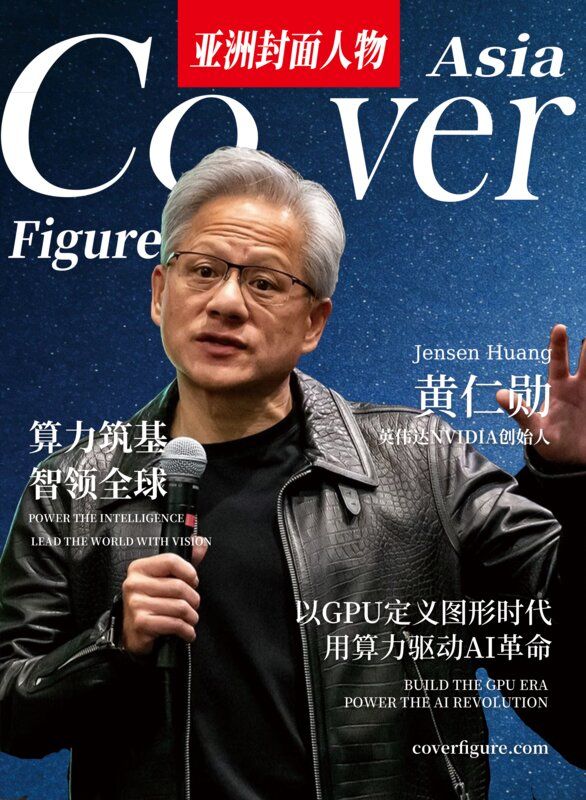
Jensen Huang
“AI Is the Platform Opportunity of This Generation”
Jensen Huang, founder and CEO of NVIDIA, has created one of the world's most valuable technology companies from graphics chips to AI computing power empire.
Jensen Huang
Asian Cover Figure | Jensen Huang: From Immigrant Youth to Architect of the AI Computing Empire
Asian "Cover Figure" Magazine · The Business Contrarian
In early 2024, global capital markets witnessed an unprecedented phenomenon: NVIDIA's market capitalization surpassed multiple tech giants in less than a year, becoming the world's most watched semiconductor company. The core person driving all this is NVIDIA co-founder and CEO Jensen Huang.
From sketching the GPU vision with two partners at a Denny's restaurant in California in 1993, to leading NVIDIA to become the indispensable infrastructure provider of the AI era, Huang spent thirty-plus years of persistence and foresight, transforming a graphics chip company into the computing engine powering the global artificial intelligence revolution.
I. The Wandering Youth: From Thailand to America, Taking Root in a Foreign Land
In 1963, Jensen Huang was born in Taiwan, China. In childhood, his family briefly relocated to Thailand. At age nine, he was sent to the United States to live with an uncle, subsequently enrolling in a Christian boarding school in Kentucky. This formative experience profoundly shaped his life. At the boarding school, he learned independence, resilience, and self-discipline — qualities that would accompany his entire entrepreneurial career.
As Huang later recalled in multiple public speeches, the boarding school experience taught him how to quickly adapt to unfamiliar environments and do his best with limited resources. He was responsible for cleaning the school's bathrooms, but he treated it as a job requiring serious attention, striving to do it perfectly. This "give everything you do your all" attitude became the foundation of his approach to running NVIDIA.
During high school, Huang demonstrated strong interest in electronics and computers. He entered Oregon State University to study electrical engineering, subsequently earning a master's degree at Stanford University. During his studies, he not only built a solid technical foundation but began forming initial thoughts about the future direction of computing.
II. The GPU Revolution: Redefining the Possibilities of Graphics Computing
In 1993, Huang co-founded NVIDIA with Chris Malachowsky and Curtis Priem in San Jose, California. The company name derives from the Latin "Invidia" (meaning "envy"), implying an ambition: to create products that would make the entire industry envious.
In the startup's early days, the PC graphics market was still in its infancy. Most computers had extremely limited graphics processing capability; 3D graphics applications remained primarily in professional workstation domains. Huang keenly foresaw that with the rapid development of gaming, multimedia, and professional applications, dedicated graphics processors would face enormous market demand.
In 1999, NVIDIA launched the landmark GeForce 256, introducing the concept of GPU (Graphics Processing Unit) to the industry for the first time. This product integrated hardware transform and lighting engines, liberating 3D graphics rendering from the CPU's burden, ushering in the era of GPU computing. This innovation not only reshaped the gaming industry but planted seeds for GPU's broad future applications in scientific computing and artificial intelligence.
Over the subsequent twenty-plus years, Huang led NVIDIA in continuously pioneering GPU technology iterations. From the GeForce series to professional-grade Quadro and Tesla product lines, NVIDIA maintained technological leadership in graphics processing. But Huang's vision never remained limited to graphics chips alone — he had been waiting for the moment when GPU capability could be unleashed across broader domains.
III. The AI Bet: Betting on Parallel Computing When No One Believed
NVIDIA's rise in the AI era was not smooth. From the late 2000s to early 2010s, when NVIDIA's main business remained gaming and professional graphics chips, Huang began investing substantial resources in building the CUDA parallel computing platform. CUDA allowed developers to harness GPU parallel computing power for general-purpose computing tasks — at the time, many Wall Street analysts and industry figures viewed this as "losing focus."
But Huang firmly believed that GPU's parallel computing architecture was inherently suited for processing the large-scale matrix operations in neural networks — and deep learning was the core direction of AI development. Against opposition, he continuously increased CUDA ecosystem investment, pushing GPU's transformation from a graphics processing tool to a general computing engine.
This strategic judgment was progressively validated after 2012. With deep learning breakthroughs, top global research institutions and enterprises adopted NVIDIA GPUs as core AI training hardware. NVIDIA leapt from a gaming chip company to the core supplier of AI infrastructure.
In 2016, NVIDIA launched the Tesla P100 accelerator designed specifically for deep learning, marking the company's formal full entry into the AI computing market. From V100 to A100, H100, and the Blackwell architecture, NVIDIA's AI chips continued breaking through in computing power, energy efficiency, and ecosystem compatibility, becoming the de facto standard platform for global AI R&D and deployment.
IV. The Trillion-Dollar Empire: The Computing Cornerstone of the AI Era
Entering 2023, the large language model wave represented by ChatGPT swept the globe, and NVIDIA's GPUs became the critical infrastructure underpinning this AI revolution. From OpenAI to major global tech companies, from research institutions to government departments, virtually every organization competing in AI was procuring NVIDIA AI chips at scale.
This demand drove explosive growth in NVIDIA's revenue and market cap. Company market value climbed from approximately $360 billion at end of 2022 to surpassing $3 trillion in 2024, making it one of the world's most valuable companies. Huang himself became one of the world's wealthiest entrepreneurs.
Yet in the face of enormous commercial success, Huang maintained impressive clarity and humility. He continued his high-intensity work habits, frequently participating in product technology reviews, appearing at events in his signature leather jacket. In a 2024 public speech, he reminded the industry: AI development remains in its early stages; the true transformation has just begun.
Under Huang's leadership, NVIDIA has built a complete AI technology stack spanning chip hardware, software platforms, development tools, and ecosystems. The CUDA ecosystem, after ten-plus years of accumulation, has gathered millions of developers globally, forming an extremely high ecosystem moat. Simultaneously, NVIDIA continues pursuing autonomous driving (DRIVE platform), robotics (Isaac platform), digital twins (Omniverse platform), and other frontier domains, demonstrating technology ambition far beyond a chip company.
V. The Contrarian's Vision: Moving Forward Through Fear, Staying Hungry in Success
Huang's management style is unique in the tech industry. He believes in flat management, directly managing dozens of executive reporting lines, avoiding decision delays from excessive hierarchy. He requires the team to approach every day with a "Day 1" mentality — even as a trillion-dollar giant, maintaining startup-era urgency and innovation drive.
He has mentioned publicly multiple times that NVIDIA is probably only 30 days from "going under." This is not false modesty but a deep crisis consciousness — in the rapidly iterating semiconductor industry, yesterday's leadership doesn't guarantee tomorrow's security. It is precisely this persistent sense of crisis that drives NVIDIA to continuously reinvent itself, preparing thoroughly before each technology cycle arrives.
From a Taiwanese youth to the helmsman of the world's most influential tech company, Huang spent thirty-plus years writing a business legend of vision, resilience, and continuous innovation. He was not a born winner but a strategist who dared to make non-consensus judgments at critical moments and was willing to endure long-term pressure for them. In the wave of AI reshaping the world, Huang and NVIDIA stand at the crest — and this story is far from over.
Follow


Scan to follow for more stories
Cover ArchiveArchive
View archive file →Every cover publication is registered and kept in the ACF Cover Archive. The code is permanent.


Not Everyone Makes the Cover
Asia Cover Figure · Influencing Those Who Influence