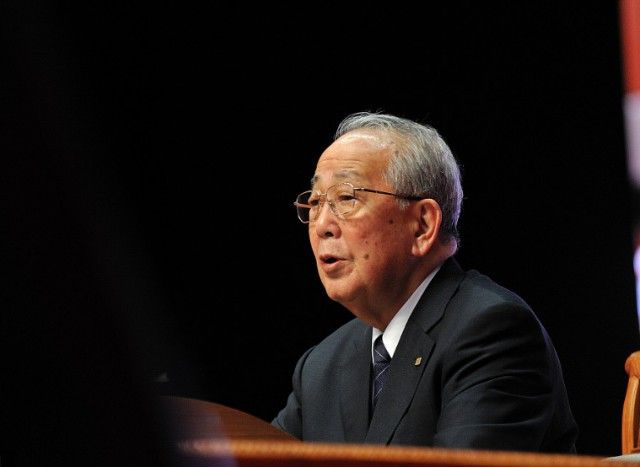
The beginning of Kazuo Inamori's life was almost limited by time and body. In his childhood, he unfortunately contracted tuberculosis. In the postwar Japanese environment where supplies were scarce and medical resources were limited, the long-term pain consumed his body and made him realize the powerlessness of reality prematurely. His frail body did not bring him a smooth growth path, but instead made him accustomed to staying calm in the face of adversity...
Kazuo Inamori
Asia cover figure·Business rebel|Inamori Kazuo: From a broken factory to a Fortune 500 company, he only asked one question
Asia's "Cover Character" Business Rebel
He suffered from tuberculosis in childhood and failed the college entrance examination twice. After graduating from college, I was rejected for a job, so I finally found a job at a ceramics factory called Shofeng Industrial. This old factory was deeply in the red, wages were in arrears for a long time, and the dormitories were in dilapidation. The college students who joined the company at the same time resigned one after another, and by autumn only two of them were left; later, even the last colleague passed the Self-Defense Force and left, leaving him alone in the dilapidated factory.
He didn't run.
He later turned this broken factory into a Fortune 500 company, Kyocera, and founded a second Fortune 500 company, KDDI. At the age of 78, he came out with zero salary and helped bankrupt JAL make a profit of 188.4 billion yen in one year.
From beginning to end, he only asked himself one question: "As a human being, what is right?"
1. Tuberculosis, failing the exam twice, and joining a bankrupt factory
The beginning of Kazuo Inamori's life was almost limited by time and body. In his childhood, he unfortunately contracted tuberculosis. In the postwar Japanese environment where supplies were scarce and medical resources were limited, the long-term pain consumed his body and made him realize the powerlessness of reality prematurely. His frail body did not bring him a smooth growth path, but instead made him accustomed to remaining silent and patient in adversity.
Entering youth, the path to education has been met with setbacks one after another. After failing the college entrance examination twice in succession, he missed out on being admitted to Japan's top universities. In the end, he could only enter Kagoshima University, a local institution, to major in applied chemistry. In Japan's employment environment at that time, academic qualifications from local universities were not competitive, which created many obstacles for him to find a job after graduation. After the war, Japan's economy was in recession, jobs in large companies were tightened, and competition for jobs was fierce. Kazuo Inamori, who came from an ordinary family, had almost no high-quality employment options.
After graduating from college, he submitted dozens of resumes one after another, but almost all of them came to nothing. When he was running into obstacles and was desperate, he got the opportunity to be hired by Songfeng Industrial. This old ceramics factory with a certain history was already in a quagmire of operations. It had chaotic internal management, old technology, tight capital chain, long-term arrears in employee wages, and very basic living conditions. The dormitories were dilapidated and damp, and the living environment was difficult.
Most of the college students who joined the factory had expectations for a decent job. After seeing the dilapidation and hopelessness of the factory, they all chose to leave their jobs and find other ways out. In a short period of time, all the peers who joined the company at the same time left, leaving only Kazuo Inamori in the workshop. Everyone around him was voting with their feet to escape from this hopeless quagmire, but he chose to stay. He did not indulge in the negative emotions caused by the poor environment, nor complained about his unfair fate. Instead, he devoted all his attention to the technological research and development of ceramic materials.
Without a complete laboratory or sufficient R&D funds, he took root in the workshop, lived and ate in the factory area, repeatedly debugged the material formula and firing process, and accumulated core technologies through boring experiments day after day. It was this time of working alone and studying in a bankrupt factory that allowed him to accumulate professional abilities in the field of precision ceramics. It also allowed him to form the underlying logic of searching inward and sticking to his heart when encountering difficulties, which paved the way for the establishment of two Fortune 500 companies in the future.
2. Starting a business at the age of 27: turning a broken factory into a Fortune 500 company
In 1959, 27-year-old Kazuo Inamori gathered eight colleagues from Matsukaze Industry who were willing to follow him and officially founded Kyocera. The starting point of starting a business is still simple. It is essentially just a small street workshop with weak funds and limited scale. It has neither industry resource blessing nor mature market channels. In the fierce competition environment of the precision ceramics industry, the living space is very narrow. Since the beginning of his business, he has established the social motto of "respecting God and loving people", putting the basic principles of life before business operations, focusing on integrity, altruism and trustworthiness, and rejecting opportunism and short-term profit-seeking.
What really allowed Kyocera to break through was the original amoeba business model created by Kazuo Inamori. Different from the traditional management style of large enterprises with cumbersome hierarchies, vague rights and responsibilities, and passive execution by employees, the core logic of Amoeba's management is to dismantle the huge enterprise organization into small units with flexible and independent accounting. He specially designed a unit time accounting sheet so that every small team can clearly see its revenue, costs, profit and loss, and output per unit time, just like an independent store on the street. He requires each amoeba (small team) to be like a street store, not only looking at sales, but also calculating "value added per unit time" so that front-line employees can instantly understand "how much money I made for the company in this hour."
This model has completely changed the relationship between companies and employees. Ordinary employees are no longer just executors who passively complete their work, but are participants with business awareness and responsibility for profits and losses. Everyone can intuitively see the value brought by their own work, proactively control costs, improve efficiency, and expand business. The internal friction within the company has been greatly reduced, the enthusiasm and sense of belonging of all employees have been fully stimulated, and team cohesion has become Kyocera's core competitiveness.
Relying on the precision ceramic technology accumulated during the Shofu Industrial period and the efficient operation brought by Amoeba operations, Kyocera has steadily entered high-end tracks such as electronic components, semiconductors, and aerospace materials. Kazuo Inamori insists on deep cultivation of technology and priority on quality, does not blindly follow the trend of expansion, rejects extensive scale competition, and gradually opens up overseas markets with stable and reliable product quality. Starting from a humble small street factory, after decades of hard work, Kyocera broke through technical barriers and market blockades and grew into a leading company in the global precision ceramics field. Around 1995, it officially became one of the world's top 500 companies. A technician who came out of a dilapidated factory used the simplest business philosophy to create the first world-class enterprise.
3. Starting a business again at the age of 52: breaking the monopoly and establishing a second Fortune 500 company
For most entrepreneurs, building a Fortune 500 company in their lifetime is the pinnacle of their careers. At the age of 52, Kazuo Inamori chose to start from scratch again and actively entered the telecommunications industry monopolized by giants to start his second business.
In the 1980s, Japan promoted liberalization reforms in the telecommunications industry, and the communications market, which had long been exclusively monopolized by NTT, ushered in a window for market-oriented competition. As a long-established Japanese telecommunications giant, NTT has decades of industry experience, abundant funds, comprehensive network coverage, and a huge user base. It controls almost the entire Japanese communications market and has extremely high industry barriers. Many capitals and companies were afraid of the size of the giants and did not dare to enter the industry rashly. However, Kazuo Inamori saw the pain points of ordinary people being suppressed by monopoly prices and decided to establish Daidenden DDI to enter the industry as a challenger and break the industry monopoly.
At that time, the telecommunications industry was an asset-heavy industry, with huge investment in network construction and a long return cycle. The market pressure caused by the squeeze from the giants was unprecedented. Second Electronics was facing an existential crisis from the beginning. The outside world is generally not optimistic about this entrepreneurial venture, thinking that he will only fail in the end if he crosses boundaries rashly and uses his small skills to make a big difference. However, Inamori Kazuo still continues his own business logic and does not compromise with the short-term thinking of capital for profit. He insists on taking altruism as the core, user experience as the guide, and focusing on communication network construction and service optimization.
He once again applied the Amoeba business model to the telecommunications industry, split the operating units, clarified the rights and responsibilities of each sector, strictly controlled costs, improved efficiency, and activated the combat effectiveness of the entire entrepreneurial team. Under the strong squeeze of NTT, Dai Daiden struggled to expand the market and accumulate users, and subsequently integrated with many Japanese communication companies to establish KDDI. Relying on stable communication services and people-friendly tariff standards, KDDI gradually seized market share, broke through the monopoly pattern of giants, and eventually grew into the second largest telecom operator in Japan, successfully becoming one of the world's top 500 companies. At this point, Inamori Kazuo has become one of the very few entrepreneurs in the world who has founded two Fortune 500 companies in his lifetime.
4. 78 years old, zero salary, save JAL
In 2010, Japan Airlines fell into huge losses due to long-term management rigidity, serious internal friction in the department, and low operating efficiency. It eventually declared bankruptcy with liabilities as high as 2.3 trillion yen, and tens of thousands of employees were at risk of unemployment. As Japan's national aviation company, JAL's bankruptcy not only impacted the aviation industry, but also affected the livelihoods of a large number of ordinary families. The Japanese government sought solutions in many ways, but many business people refused to take over due to huge debts and complex internal problems.
Kazuo Inamori, who was already 78 years old at the time and had long since retired, chose to take over the crisis and took over the reconstruction of JAL. He also put forward the only condition: to serve at zero salary and not receive any salary remuneration, just to save the company and employees.
Faced with internal decay and disunity at JAL, he did not make drastic adjustments to routes, cut costs, or restructure the business as soon as he took office. In his opinion, the root cause of business problems is the problem of people's hearts. He spent several months traveling to various departments of JAL across the country to conduct rotation training for all middle-level and above cadres. He only repeatedly asked one core question throughout the process: "As a human being, what does it mean to be right?" He does not preach complex business theories or pile up cold financial data. He only guides every manager to think about responsibility, responsibility, altruism and the bottom line. He abandons the mentality of departmental self-interest and mutual blame, and establishes a value perception that puts the company, employees and passengers first.
After the values were unified, he implemented tough business reforms, including laying off about 16,000 people and cutting off loss-making routes. This allowed him to go from being a "philosophical mentor" at the beginning to returning to the real battlefield of operators. This constitutes two seemingly contradictory but actually unified aspects of Kazuo Inamori's management philosophy: extreme altruism in terms of values (respecting heaven and loving others), and extreme rationality in business decisions (layoffs and business cuts). The former gathers people's hearts, while the latter ensures survival.
When the management's thoughts and mentality were completely changed, Inamori Kazuo officially implemented the business reform. He introduced the Amoeba business model to JAL, split the huge operating system, clarified the accounting standards and profit and loss responsibilities of each unit, optimized the route layout, cut off inefficient routes that suffered long-term losses, strictly controlled operating costs such as fuel, manpower, and services, while strengthening front-line service awareness and improving passenger travel experience.
The effects of the reform were immediate. In the March 2011 period, the first full fiscal year after reconstruction, JAL achieved an operating profit of 188.4 billion yen, the highest profit in corporate history; in the second fiscal year, operating profit further increased to 204.9 billion yen. In just three years, JAL completed debt repayment, relisted on the Tokyo Stock Exchange, and once again became one of the world's top 500 companies. At the age of 78, he came out of the business with zero salary and used simple principles to save a national enterprise that was on the verge of extinction.
5. He is not a business sage, he just refuses to accept his fate.
Two of the world's top 500 companies saved JAL at an advanced age. The outside world is accustomed to defining Kazuo Inamori as the "sage of management" and attributes his success to talent and legend. But looking back on his life, all his achievements stem from his perseverance and refusal to accept fate in the face of adversity.
When his career reached its peak, Kazuo Inamori chose to become a monk and let go of his reputation as an entrepreneur. He does not hold wealth tightly in his hands, but deeply binds personal equity to employees through mechanisms such as employee stock ownership meetings, truly practicing the altruistic core of his business.
The success equation he proposed directly states the core logic of life: success = way of thinking × passion × ability. Ability can be accumulated through acquired learning and practice, enthusiasm can be maintained by one's own will, and integrity, altruism, and positive thinking are the key to overcoming all difficulties.
Throughout his life, suffering from childhood illness, failure in schooling, obstacles in finding a job, obstacles in starting a business, confrontation with industry giants, and the heavy burden of rebuilding the company at an advanced age were all the hardships that always accompanied him. He has no natural advantages, no capital support, and no shortcuts. He just sticks to the bottom line of being a human being and insists on doing the right thing in every desperate situation.
He once left a sentence: "Success and failure are both a kind of hardship." When you succeed, you don't be greedy for fame and fortune, and you know how to share and let go; when you fail, you don't indulge in despair, and you are willing to sink your heart and take root. In this life, he did not chase the peak of worldly definitions, but always followed his true heart, refused to accept fate or compromise, and used the simplest value judgment to complete the most difficult business life.
[Abstract of public account]
I failed the college entrance examination twice, and my first job didn’t even pay me a salary. He later started from scratch and founded two Fortune 500 companies. At the age of 78, he came out with zero salary and helped bankrupt JAL make a profit of 188.4 billion yen in one year. Kazuo Inamori is not a business sage, he just never accepts his fate.
[Data source description]
Kazuo Inamori's early life experiences (tuberculosis, failing the college entrance examination twice, Kagoshima University, being rejected for job hunting, Matsukaze Industry): "The Autobiography of Kazuo Inamori"
Kyocera was founded in 1959, amoeba management, unit time accounting table: official development history of Kyocera Group, "Kyocera Philosophy"
Kyocera became a Fortune 500 company around 1995: Official development history of Kyocera Group, Fortune Global 500 list
Founded Daiden Denden (DDI) in 1984, which was later integrated into KDDI and became a Fortune 500 company: public information from Japan’s Ministry of Economy, Trade and Industry, official development history of KDDI
Kazuo Inamori ordained as a monk, employee benefit sharing mechanism: public figure reports
In 2010, JAL went bankrupt, with debts of 2.3 trillion yen, and Kazuo Inamori came out with zero salary: JAL official announcement, Japanese government announcement
Operating profit of JAL was 188.4 billion yen in the first year of reconstruction, 204.9 billion yen in the second year, and re-listed in three years: JAL’s financial reports over the years, reported by Kyodo News
"Success and failure are both hardships": Record of Kazuo Inamori's public speech