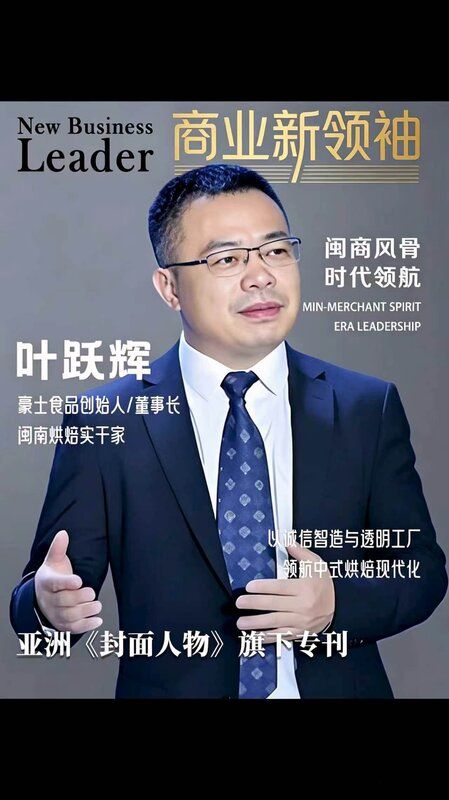
This issue places Ye Yuehui in the 'New Business Leader' column, not because his company is the largest or loudest, but because he represents a rare long-termist path in the wave of internet-famous economy. While most brands chase traffic dividends and marketing-driven growth, Ye spent 21 years honing products and supply chain, then achieved explosive growth in 7 years, proving the business logic that 'slow is fast.' His archival value lies in how an entrepreneur without prominent background or capital acceleration can, through deep industry understanding and extreme pursuit of product quality, open a new track in a seemingly saturated bakery market and build an insurmountable competitive barrier. This growth model centered on product strength and supply chain offers another template for 'new business leaders'—not disruptive innovation, but deep-cultivation breakthrough.
Ye Yuehui's entrepreneurial trajectory shows a distinct two-phase pattern: 21 years of deep cultivation followed by 7 years of explosive growth. In 1995, at age 16, he started from a family bakery, accumulating knowledge of ingredients, taste, and market during the industry's infancy. [1] In 2005, he returned to Zhangzhou to found Tianguan Food Factory, starting scaled production; in 2010, he built a factory in Henan; in 2011, he adopted the 'House' brand; and in 2015, he launched the first pocket bread to test the market. [1] These early moves laid the groundwork for later success. Around 2016, House (Fujian) Food Co., Ltd. was formally established, and Ye's career entered a fast track. [1] In 2017-2018, the probiotic pocket bread became a phenomenal blockbuster, creating the new sub-category of 'pocket bread'. [1] In 2020, the Nanjing Smart Industrial Park, with a total investment of 1.05 billion RMB, was put into operation, greatly expanding capacity. [2] In 2021, House bread won the International ITI Taste Award, gaining international recognition for quality. [3] By industry estimates, House's revenue in 2023 approached 2 billion RMB, making it an invisible champion in the leisure bakery industry. [4]
Ye Yuehui's business philosophy can be summarized as 'blockbusters are calculated' and 'supply chain is the real moat.' In creating blockbusters, House did not follow trends but created a new track based on market insight. The success of the probiotic pocket bread stemmed from a precise understanding of young consumers' needs: smaller sizes for single-serve convenience, healthier formulas, and expansion into meal replacement, snacks, and afternoon tea scenarios. [1] This product logic was widely copied by brands like Three Squirrels and Bestore, but as the pioneer, House retained the power to define the rules. [1] In supply chain, Ye insists on full-industry-chain layout, building a digital intelligent supply chain system with fine-grained control from raw material procurement, production, to warehousing and logistics. [5] Product development is driven by massive user tasting data, iterating formulas in reverse. [5] Meanwhile, House adheres to the principle of 'only use real ingredients to make good bread,' strictly controlling ingredient quality and rejecting additive stacking. [5] This long-term investment in supply chain and quality enables House to escape the fate of short-lived internet-famous brands and build an insurmountable competitive barrier.
Ye Yuehui's impact on the industry is mainly in three aspects: creating a category, defining rules, and setting a long-termism example. The birth of the probiotic pocket bread made 'pocket bread' an important sub-category in leisure baking, and House became the pioneer and rule-setter. [1] Its product logic was imitated by many well-known brands, driving product innovation and upgrade across the industry. [1] In channel construction, House products reach over 100,000 sales points nationwide, from convenience stores in first-tier cities to mom-and-pop shops in lower-tier markets, building a nationwide sales network that connects the 'capillaries' of the baking industry. [6] This channel infrastructure provides a replicable model for the industry. In business philosophy, Ye's low-key pragmatism and long-termism offer a counter-example in the internet-famous economy era: not chasing traffic, focusing on products and supply chain, and achieving sustainable growth. [7] By industry estimates, House's revenue in 2023 approached 2 billion RMB, proving the commercial value of this model. [4] Ye himself is low-key and rarely appears publicly, but his simple philosophy of 'doing the daily things well' has become a spiritual benchmark in the baking industry.
Ye Yuehui's business practice leaves a core proposition: in an era where traffic reigns, can long-term investment in product and supply chain still constitute the strongest moat? The rise of House Food gives an affirmative answer. With 21 years of foundation and 7 years of explosion, he proved the simple power of 'doing the daily things well.' As internet-famous brands rise and fall, House has achieved the leap from blockbuster to enduring success through real ingredients and full-chain control. His archive reminds future leaders: true business leaders are not those who chase trends, but those who have quietly laid a solid foundation before the trend arrives.