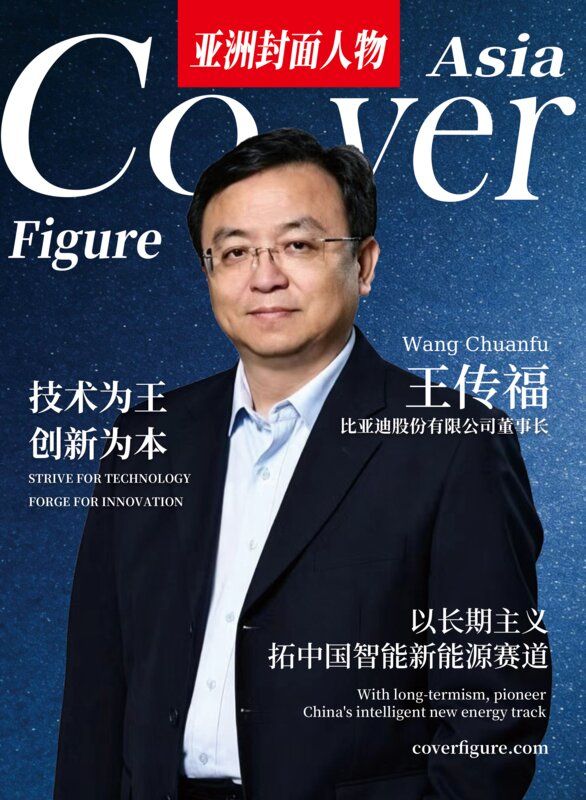
Green energy is not a multiple-choice question, it is a must-answer question. BYD wants to use technology to change the world.
Wang Chuanfu is included in the 'Perspective' section not only for his personal rise from an impoverished orphan to an industry leader, but also for his strategic determination at critical junctures. When outsiders questioned his move into automobiles, he saw the trend of energy transformation; when the NEV market was still nascent, he insisted on long-term investment. This ability to see beyond short-term interests, coupled with his dedication to technological self-reliance, defines his perspective. His archival value lies in documenting how an industrialist, using technology as a blade, carved his own path through the waves of the era.
Wang Chuanfu's entrepreneurial journey began in 1995 when he resigned from his stable position at the Beijing General Research Institute for Non-Ferrous Metals and founded BYD in Shenzhen. Initially, BYD focused on producing rechargeable batteries. Facing foreign technology blockades, Wang led the team to break the monopoly through process innovation and cost control, becoming a major player in the global rechargeable battery sector. In 2002, BYD was listed in Hong Kong, laying the foundation for future growth.
In 2003, Wang made the decision to enter the automobile industry, acquiring Xi'an Qinchuan Automobile. This decision was widely questioned at the time, but Wang believed that new energy was the future of the automotive industry. In 2005, the BYD F3 was launched, becoming a market hit due to its high cost-performance, helping BYD establish a foothold in the auto market. Since then, while steadily developing its fuel vehicle business, BYD has continuously invested in new energy technology R&D, gradually building a full supply chain capability in batteries, motors, and electronic controls. [2] [3]
Wang Chuanfu's business philosophy centers on technological self-reliance and long-termism. He firmly believes that core technology must be mastered in-house, so BYD insists on full supply chain self-research and self-production, from batteries, motors, and electronic controls to chips, building a complete vertical integration capability. This model has shown significant advantages during supply chain disruptions, enabling BYD to effectively control costs and promote NEV adoption at more accessible prices.
Wang's long-termism is reflected in his persistence amid skepticism. In the early days when the NEV market was immature, he withstood pressure and continued to invest in R&D, quietly accumulating technology. The launch of core technologies such as Blade Battery and DM-i hybrid is the result of long-term investment. He advocates not chasing short-term trends but doing the right things for the long term, a philosophy that runs through BYD's development. [5] [6]
The success of Wang Chuanfu and BYD is not just the rise of a company, but a microcosm of China's manufacturing transformation and upgrading. BYD's breakthroughs in the NEV sector have driven China's auto industry from a follower to a leader. In 2023, BYD sold 3,024,400 NEVs, ranking among the top globally, showcasing the competitiveness of Chinese brands.
Wang's low-key and pragmatic style echoes his commitment to industrial service to the country. He has repeatedly emphasized the importance of green energy, calling it a must-answer question rather than a multiple-choice question. His experience inspires countless entrepreneurs, proving that one can rise from poverty and that technology can change destiny. BYD's rise also provides a model for China's auto industry to overtake on the new energy track, and its full supply chain model has become a subject of industry research. [4] [6]
The business proposition Wang Chuanfu leaves behind is: how to counter short-term temptations with long-termism during a window of technological change. He has proven over nearly three decades that true perspective is not about chasing trends, but about foreseeing the endgame. BYD's success provides a model of 'technological self-reliance plus full supply chain' for Chinese manufacturing. His significance lies in showing the world that China's auto industry can not only catch up, but also lead. What this archive seeks to preserve is how an industrialist embedded his personal destiny into the grand narrative of national industrial upgrading.