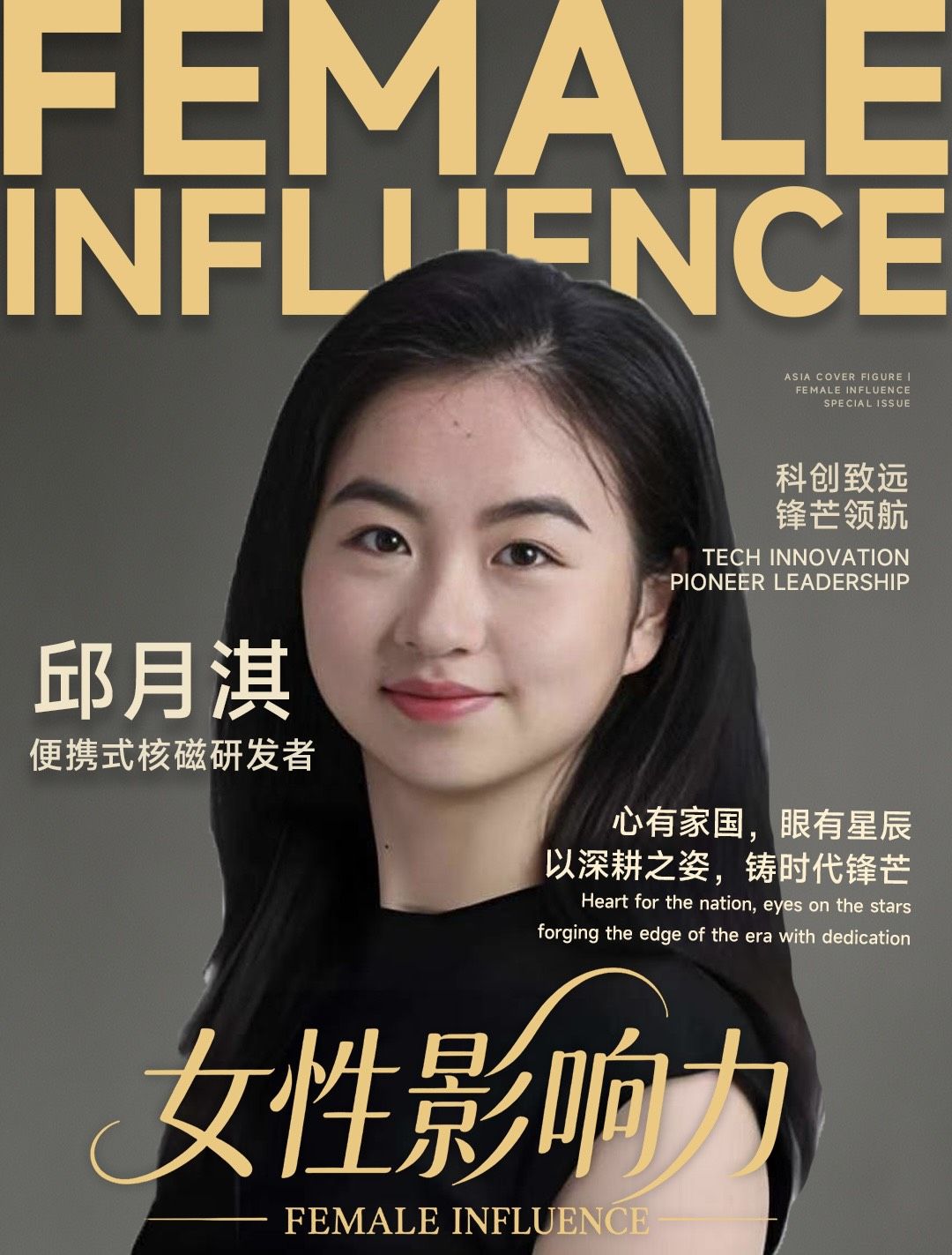
Editor's introduction: Qiu Yueqi is included in the 'Perspective' section not because of her youth, but because she chose the hardest path in the established pattern of global technology monopoly—breaking through from fundamental principles rather than optimizing within existing frameworks. She faced an industry-wide 'impossible', yet rewrote the rules with original technology. This scientific spirit of not blindly trusting authority and daring to overturn and start anew, coupled with her people-oriented sentiment of bringing technology to the grassroots, constitutes a pattern that transcends her age. Her archival value lies in recording how a post-2000 researcher used technology as a blade to cut through the ice of monopoly while maintaining sensitivity to real needs.
Qiu Yueqi was born in 1999, grew up in an era valuing technology and people's livelihoods, and had a strong interest in biomedical engineering. With excellent grades, she was admitted to Shanghai Jiao Tong University, progressed to doctoral studies, focusing on magnetic resonance imaging. Through long-term research, she saw that high-end medical equipment was monopolized by foreign countries, and grassroots medical settings faced equipment shortages, expensive examinations, and inconvenient access. The low-field portable MRI track was globally recognized as a 'hard problem', with industry consensus that low-field equipment suffered fatal flaws such as non-uniform magnetic fields and imaging distortion rates as high as 15%, making it unsuitable for clinical use. But Qiu Yueqi was determined to break this bottleneck, leading her team into the attack. Initially optimizing within traditional frameworks, the distortion rate could only be reduced to 8%, far from clinical standards. After extensive literature review and data analysis, she found that traditional technology over-relied on absolute uniformity of hardware, which was an insurmountable shortcoming for portable devices. She decisively overturned previous results, starting from the underlying principles of signal encoding, and finally developed the original SPEN spatiotemporal encoding technology, reducing the geometric distortion rate of low-field MRI from 15% to 0.7%, improving anti-distortion capability by over 20 times, completing full-brain 3D scanning in just 3 minutes, with imaging resolution approaching international high-end equipment. [1]
Qiu Yueqi's research philosophy emphasizes solving real problems and serving real needs. She believes that research is not lofty fantasy but must be grounded in grassroots reality. In the technical battle, she chose to overturn and start from scratch, reflecting a deep understanding of the essence of research: research fears stagnation most; compared to the regret of failure, the fear of not breaking through is the greatest waste. She led her team to work in an underground laboratory for three consecutive months, adjusting parameters day and night, recording data, optimizing plans, almost isolated from the outside world. To make the technology fit grassroots needs, she went through thousands of medical reports and repeatedly communicated with township doctors. In the transformation phase, she turned the original large MRI equipment weighing over ten tons and costing tens of millions of yuan into a portable device the size of a suitcase costing only 130,000 yuan, requiring no dedicated room and working with a standard 220V outlet. She also compiled simple operation manuals and trained township doctors on-site. Currently, the technology has been deployed in Yunnan, Guizhou, Gansu, and other places, entering 23 township health centers, screening over 3,000 major diseases such as cerebral infarction and brain tumors, with 87 early-stage cerebral infarction patients catching the 'golden 6-hour' treatment window. [1]
Qiu Yueqi's achievements filled the domestic gap in low-field MRI technology and attracted global attention. In 2025, she became the first Chinese researcher to receive the Prince-Meaney Translational Science Award, the highest global award in the MRI field. Her technology not only enhanced China's independent innovation capability in high-end medical equipment but also provided affordable solutions for grassroots healthcare. Her story inspires the younger generation of researchers, showcasing the strength and responsibility of China's young researchers. She remains humble, considering herself an ordinary post-2000 researcher with a bit more obsession with technology and concern for people's livelihoods. Her work embodies the spirit of 'writing papers on the motherland', transforming research results into practical applications serving grassroots communities. [1]
The business proposition Qiu Yueqi leaves behind is: in fields where core technology is monopolized, how can the younger generation achieve 'lane-changing overtaking' through original breakthroughs? Her story proves that technological breakthroughs require not only intelligence but also the courage to confront real problems and the execution to turn results into affordable products. She reduced high-end equipment from tens of millions to 130,000 yuan, from over ten tons to a suitcase size—this is not just an improvement in technical indicators but a revolution in business logic, making grassroots markets a testing ground for technology deployment. Her significance lies in providing a replicable paradigm for China's independent innovation in medical technology: starting from people's pain points, driven by underlying innovation, and ultimately achieving technological equity.