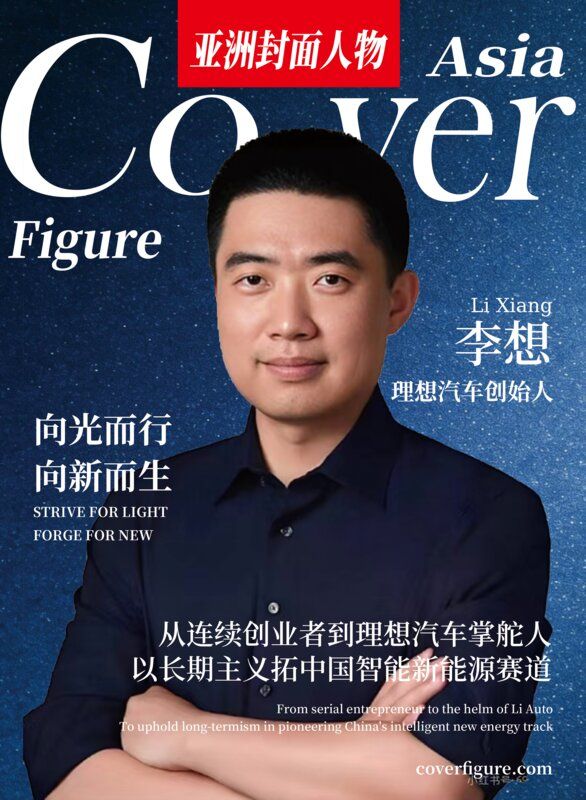
The best definer of a product is the user, and all we have to do is listen and implement.
Li Xiang is included in the 'Perspective' section not because all three of his ventures succeeded, but because after each reset, he recalibrated and bet on the next era. From internet to car manufacturing to embodied intelligence, his crossovers were not about chasing trends, but based on judgments of user needs and industry endgames. This ability to persist amid doubt and move forward through ups and downs is the archival value this section aims to preserve.
Li Xiang's entrepreneurial career began in the internet. In 1999, he gave up the college entrance exam to found Paopao Net, and through extreme dedication to content, the site's daily traffic quickly rose, with annual revenue approaching 20 million RMB by age 23. [1] In 2005, he founded Autohome, which he built into a leading Chinese auto vertical media through user-generated content and data-driven models, and led its NYSE listing in 2013, with market cap briefly exceeding $5 billion. [2] However, shortly after the listing, Li gradually lost control of the company and was eventually forced out. [1] In 2015, he mortgaged all his assets to found Li Auto, entering car manufacturing. Despite skepticism, he chose the extended-range technology route, focusing on family mobility, and entered the six-seat SUV segment with the Li ONE. [1] In 2020, Li Auto listed on Nasdaq, just five years after its founding. [3] Subsequently, Li Auto faced challenges such as the mercury incident, discontinuation controversy, and price wars, but Li Xiang insisted on product excellence, eventually achieving breakthroughs in intelligent driving. [4] [5]
Li Xiang's business philosophy is centered on 'the best definer of a product is the user', advocating deep engagement with user groups to listen to real needs, rather than chasing flashy features. [6] In Li Auto's development, he insisted on focusing on family mobility scenarios, cutting redundant functions, and optimizing space, safety, comfort, and range. [1] Facing controversy over extended-range technology, he adhered to a pragmatic route, believing that solving users' range anxiety is more important than technological advancement. [1] In intelligent driving, he also adopted a cost-effective approach, achieving end-to-end city NOA with a single chip, reflecting a cost-benefit priority. [5] In 2026, he announced a pivot to embodied intelligence, laying out foundation models, chips, and humanoid robots, demonstrating keen judgment of future trends. [1] Li's management style emphasizes facing failure head-on; he once said, 'I am not a genius, just more willing to face failure than others.' [1]
Li Xiang's entrepreneurial journey has profoundly impacted China's internet and new energy vehicle industries. Autohome changed the way auto information is accessed, promoting the integration of auto e-commerce and media. [2] Li Auto's success validated the market viability of extended-range technology, drawing industry attention to family mobility scenarios. [1] As of February 2026, Li Auto's cumulative deliveries exceeded 1.59 million units, with a leading supercharging network. [5] Li's pivot decision also sparked widespread interest in embodied intelligence, positioning him as a representative of cross-border innovation. [1] Despite controversies, Li Xiang has won market and user recognition through pragmatic product philosophy and user orientation, becoming a model for a new generation of Chinese entrepreneurs. [6]
Li Xiang leaves a business proposition: in an era of rapid technological iteration, how to balance pragmatism and foresight? He chose to anchor on users, insisting on cost-effectiveness in extended-range and intelligent driving, while early positioning in embodied intelligence. His journey proves that true vision is not always standing at the forefront, but being able to see the direction even when the tide recedes.