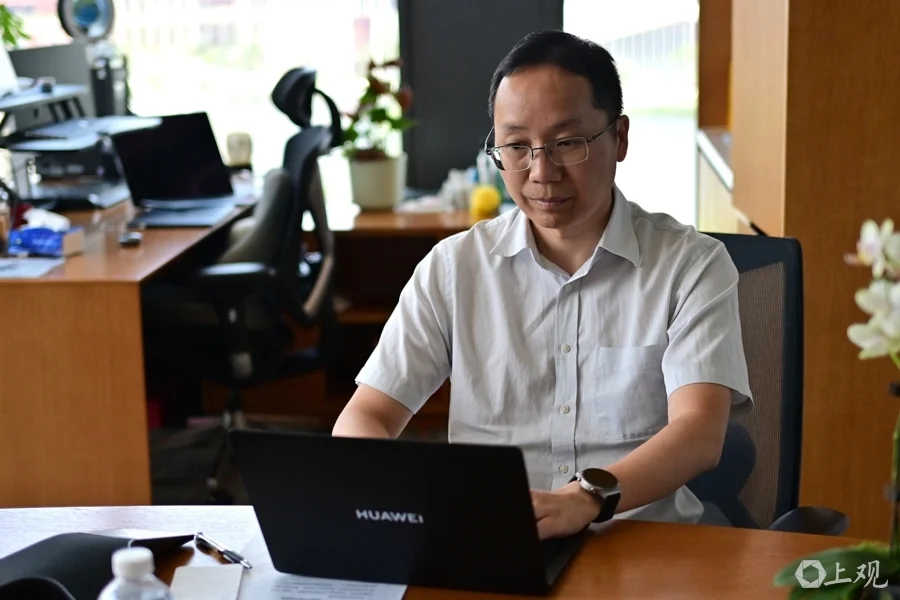
Chen Haibo is included in the 'Pattern' section not for his academic titles or corporate positions, but because he chose a path less traveled: in the underlying field of operating systems, monopolized by the West for decades, he moved from academic breakthrough to industrial implementation, building a self-reliant technical foundation over more than two decades. His value lies not in single achievements but in combining personal academic pursuits with national industrial needs, creating an open ecosystem through OpenHarmony. This transformation from 'being defeated by a virus' to 'building a wall for the country' reflects an industrial vision and long-term pattern that transcends personal gains.
Chen Haibo's career shows a clear dual track of academia and industry. The 2003 Shockwave virus incident became a turning point; he completed his bachelor's, master's, and doctoral studies at Fudan University, with his doctoral thesis awarded national excellence in 2011. That year he joined Shanghai Jiao Tong University and was promoted to professor. In academia, he broke the Asian barrier at SOSP in 2011, published multiple SOSP/OSDI papers, and in 2017 chaired SOSP and ACM SIGOPS, the first Chinese and non-North American scholar to do so [1] [3]. In 2017, he joined Huawei as director of the OS kernel lab, shifting to industry [4]. In 2020, with the launch of OpenHarmony, he was appointed TSC chair, leading the technical direction and ecosystem [4]. He also serves as CEO of Shenkaihong, driving commercialization [5]. This path exemplifies the transition from basic research to industrial application, making him a key bridge between academia and industry.
Chen Haibo's core philosophy revolves around 'self-reliance' and 'ecosystem win-win'. He emphasizes that operating systems are the foundation of the digital world and must be self-controlled [1]. In advancing OpenHarmony, he advocates that 'OpenHarmony is not an operating system, but a collection of capabilities', positioning it as a universal base for various hardware scenarios [4]. He promotes industry-academia collaboration, establishing technical clubs in over 50 universities, attracting over 70 co-building units, with over 395 ecosystem partners and 980+ products passing compatibility tests [8] [9]. On commercialization, he leads Shenkaihong to establish industry associations, set up special funds, and forge hardware partnerships, building a full-loop from technology to capital [5] [6] [7]. These actions reflect his belief that 'technology must land, requiring commercial soil', maximizing value through ecosystem synergy.
Chen Haibo's impact spans academic, industrial, and national strategic levels. Academically, he broke the long-standing monopoly of Western countries in top OS conferences, enhancing China's voice in the field [1] [3]. Industrially, OpenHarmony under his leadership has become a major force in China's self-developed OS, with over 110 million lines of code and 8,200+ contributors as of October 2024, its microkernel passing CCEAL6+ certification, and its ecosystem covering livelihood, industry, and IoT [4] [8]. At the national strategic level, OpenHarmony is seen as a key measure for achieving core technology self-reliance, drawing attention from official media and industry [8] [9]. Chen's transformation from scholar to industry leader is viewed as a typical example of 'from being defeated by a virus to building a wall for the country' [1]. His work not only advances an open-source project but also lays the foundation for the future of China's OS industry.
Chen Haibo leaves a business proposition: how to achieve self-reliance in core technologies through open-source collaboration and ecosystem building. He proved that academic research can seed industrial change, and industrial implementation can feed back into academia. The growth of OpenHarmony offers a replicable paradigm—using openness against closure, ecosystem against monopoly. His era significance lies in embedding personal destiny into the grand narrative of national technological independence, completing a transformation from individual powerlessness to collective strength over 23 years. This archive records not just one person's struggle, but a microcosm of an industry from catching up to running alongside.