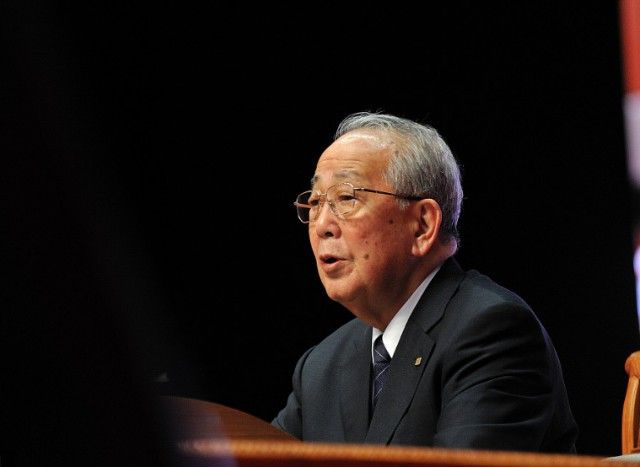
The meaning of life is to polish one's soul.
Inamori is classified as a 'Business Rebel' not only because he founded two Fortune 500 companies from scratch, but because he consistently chose to go against the current in every desperate situation. From childhood illness, academic setbacks, and job hunting failures to his perseverance in a broken factory, he was never defined by his circumstances. When founding Kyocera, he faced a factory that colleagues were fleeing; when founding DDI, he challenged the monopoly NTT; when taking over JAL, he inherited a debt of 2.3 trillion yen. His rebellion was not blind risk-taking but a clear judgment based on 'what is right as a human being'. His archival value lies in how a person without background or resources used the simplest moral principles to achieve remarkable success in the business world.
Inamori's entrepreneurial journey began in 1959 when, at age 27, he founded Kyocera with eight colleagues in Kyoto. Initially small and resource-limited, Kyocera leveraged Inamori's precision ceramics expertise to expand. His unique 'Amoeba Management' system divided the company into small units with independent accounting, motivating employees and driving rapid growth. In 1984, at 52, he founded DDI to enter telecommunications, challenging NTT's monopoly. Despite skepticism, he adhered to 'altruism', eventually developing DDI into KDDI, Japan's second-largest telecom operator. Both companies became Fortune 500, making him one of the rare founders of two Fortune 500 companies. [1] [2]
Inamori's management philosophy centers on 'Respect the Divine and Love People', emphasizing correct human conduct: altruism, integrity, and trustworthiness. His 'Amoeba Management' system, through small-group independent accounting, encourages employees to think like managers, achieving 'management by all'. He also proposed the 'Success Equation': Success = Mindset × Enthusiasm × Ability, highlighting the importance of mindset (values). In JAL's reconstruction, he first conducted 'philosophy education' to unify executives' thinking before implementing reforms, reflecting his 'heart-centered' management. [1] [5]
Inamori is hailed as the 'Saint of Management', and his philosophy and management methods have influenced entrepreneurs worldwide. He founded 'Seiwajuku', a school that trained thousands of entrepreneurs in his principles. His late-life rescue of JAL with zero salary is seen as a model of corporate social responsibility. His books, such as 'A Compass to Fulfillment' and 'The Way of Living', are bestsellers and classics in management. His success lies not only in business achievements but also in integrating morality and altruism into corporate management, providing spiritual guidance for modern business. [1] [6]
Inamori's legacy poses a business question: What is the purpose of a company? His answer was 'to make employees happy and customers satisfied'. He demonstrated that altruism is not a hindrance to business but the most sustainable competitive advantage. His 'Amoeba Management' and 'Respect the Divine' philosophy offer a perspective beyond profit. His significance lies in reintroducing morality into business rationality, reminding entrepreneurs not to forget the fundamentals of being human while pursuing efficiency. His rebellion was not against trends but against the current, holding onto a simple correctness in a restless business world.