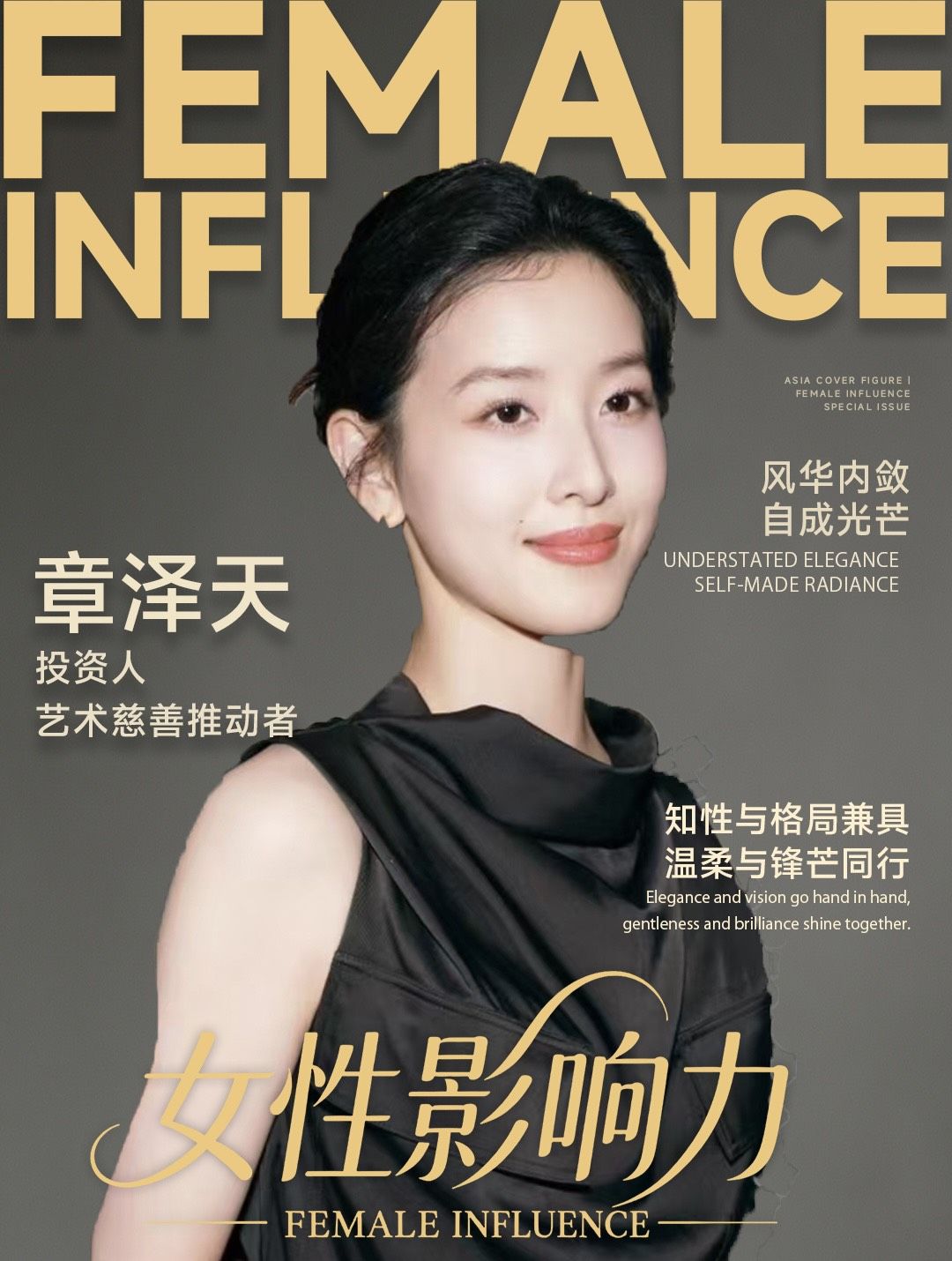
In 2009, a campus photo of him holding milk tea brought 16-year-old Zhang Zetian into the public eye overnight. The title "Milk Tea Sister" quickly spread across the Internet and became a popular label that has followed her for many years. The overnight popularity brought a steady stream of exposure resources, and the entertainment, film and television industry successively offered cooperation invitations, trying to mold her into a popular artist. Faced with easy exposure...
Zhang Zetian
Asian Cover Figure | Zhang Zetian: Beyond the "Milk Tea Sister" — A Young Woman's Journey from Internet Fame to Investment Power
Asian "Cover Figure" Magazine · Vision
Issue No. 048-
In China's internet culture, few figures have been as photographed, discussed, and misunderstood as Zhang Zetian. Known to millions as "Milk Tea Sister" — a nickname earned from a 2009 photograph of her holding a cup of milk tea, her youthful face framed by a gentle smile — she has spent the past decade and a half navigating the uncomfortable space between viral fame and genuine achievement.
Her marriage to Liu Qiangdong (Richard Liu), founder of JD.com, turned her into one of China's most scrutinized young women. But behind the tabloid headlines lies a more complex story: a woman who has quietly built a career in venture capital and impact investing, channeling billions of yuan into technology, education, and social enterprises. The "Milk Tea Sister" label may have defined her public image, but it no longer defines her influence.
I. The Photograph That Launched a Thousand Stories
In 2009, a high school student in Nanjing was photographed holding a cup of milk tea. The image, uploaded to a forum by a classmate, went viral. Zhang Zetian was 16 years old, studying at a prestigious foreign language school, with no particular interest in internet fame. The photograph captured something intangible — a combination of youth, beauty, and authenticity that resonated with a public hungry for wholesome celebrities in an increasingly cynical media landscape.
The nickname "Milk Tea Sister" stuck. Zhang Zetian became one of China's earliest examples of accidental internet celebrity — famous not for any achievement, but for an image. She was invited to television programs, featured in magazine spreads, and relentlessly discussed on social media. For a teenager, the attention was both flattering and overwhelming.
Yet even at that age, Zhang displayed a quality that would define her later career: an ability to absorb attention without being consumed by it. She continued her studies, gained admission to Peking University's sports arts program (a path chosen for its flexibility rather than passion), and maintained a relatively low profile throughout her college years.
II. Marriage, Scandal, and Survival
Zhang Zetian met Liu Qiangdong, 19 years her senior, while interning at JD.com during her time at Peking University. Their relationship, which culminated in marriage in 2015, immediately became one of China's most-discussed celebrity couplings. The age gap, the wealth disparity, and the power dynamics were endlessly analyzed in media and social commentary.
The couple's relationship faced its most serious test in 2018, when Liu Qiangdong was arrested in Minnesota on sexual assault allegations (charges were later dropped, though a civil suit resulted in a settlement). The incident dominated Chinese media for months, placing Zhang Zetian in an impossible position. Public sympathy was divided — some saw her as a victim of her husband's behavior, others as a calculating beneficiary of his wealth.
What followed was notable for its restraint. Zhang Zetian did not issue public statements, did not engage in media battles, did not follow the predictable script of either outraged spouse or devastated victim. She continued her investment work, updated her social media occasionally with photos of her children, and allowed the storm to pass. In Chinese media culture, this was interpreted as either remarkable composure or strategic calculation — perhaps both.
The couple remained together. Whether this represented forgiveness, pragmatism, or something more complex is a question that only they can answer. But the public narrative shifted: Zhang Zetian was no longer seen merely as a young wife, but as someone who had survived an extraordinary public ordeal with her dignity intact.
III. The Investor Emerges
While the public focused on her personal life, Zhang Zetian was quietly building a professional identity in venture capital. In 2014, she participated in an exchange program at Barnard College, Columbia University, where she was exposed to Silicon Valley's venture ecosystem. The experience sparked an interest in early-stage investing that would become her primary professional focus.
Working within JD.com's investment arm and later through her own vehicle, she began making bets on consumer brands, education technology, and healthcare startups. Her investment philosophy emphasized young founders, particularly women entrepreneurs, and companies that combined commercial viability with social impact. By 2023, she had participated in investments totaling several billion yuan across dozens of companies.
Her most notable investments include stakes in prenatal care provider JoyBaby, fitness app Keep, and various education platforms. While none of these have become household names, they reflect a consistent thesis: that the next generation of Chinese consumer companies will be built by younger, more diverse founders addressing underserved markets.
IV. Philanthropy and Public Health
In recent years, Zhang Zetian has increasingly focused on philanthropic initiatives, particularly in maternal and child health. She has donated to hospitals and research institutions, supported maternal mental health programs, and used her platform to raise awareness about issues that remain stigmatized in Chinese society.
This focus is partly personal — as a mother of three, she has spoken about the challenges of balancing career and family in ways that resonate with many young Chinese women. But it is also strategic: by aligning herself with causes that are both socially important and politically safe, she has carved out a public identity that exists independently of her husband's business empire.
V. Redefining the Narrative
At 31, Zhang Zetian occupies an unusual position in Chinese public life. She is simultaneously one of the country's most recognizable faces and one of its least understood professionals. The "Milk Tea Sister" who went viral at 16 has evolved into an investor, philanthropist, and — perhaps most importantly — a case study in how internet celebrity can be transformed into substantive influence.
Her journey raises uncomfortable questions about how Chinese society evaluates young women in the public eye. Why is it difficult to take seriously a woman who became famous for a photograph? Why is marriage to a wealthy man seen as disqualifying from professional achievement? Why does the public insist on defining women by their relationships rather than their work?
Zhang Zetian has not answered these questions directly. Instead, she has simply continued working — making investments, supporting causes, raising her children, and gradually building a body of work that may, in time, overshadow the photograph that made her famous. Whether that will be enough to change public perception remains to be seen. But the "Milk Tea Sister" is no longer just a face — she is becoming a force.