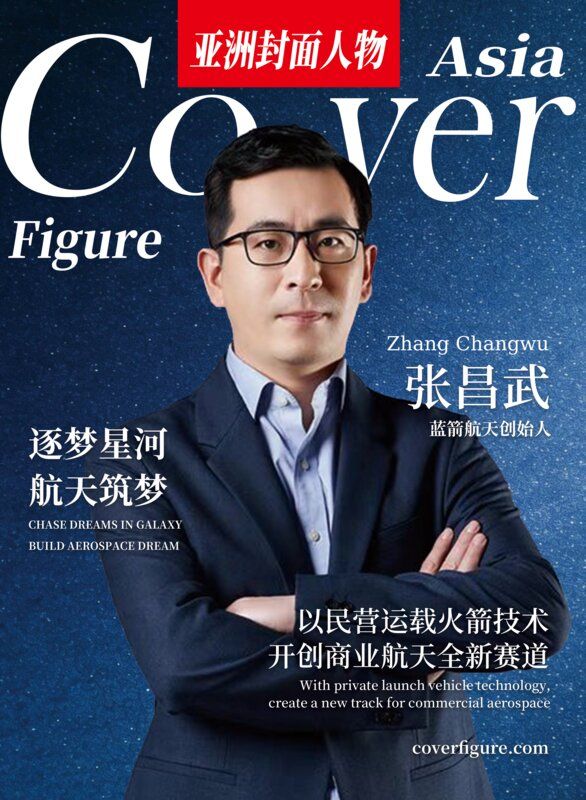
The starry sea of commercial aerospace requires solid engineering capabilities to be realized step by step.
Zhang Changwu is included in the 'Perspective' section because his choices transcend personal career trajectory, pointing to a theme of the era: when national strategy and industrial opportunity converge, how can a non-professional finance elite leverage vision and courage to break into a high-barrier industry? He gave up financial stability to build rockets from scratch, which is not only a personal adventure but also a judgment on the future of China's commercial space. His archival value lies in proving that private forces can play a key role in national strategic fields, and his persistence and foresight provide a reference path for future generations.
Zhang Changwu graduated from Tsinghua University's School of Economics and Management and later joined HSBC, accumulating extensive financial experience. In 2015, when national policy encouraged private capital into the space sector, he keenly seized the opportunity and resolutely resigned to start a business. He rented a 70-square-meter office south of Beijing's Fifth Ring Road and formed the core team. Early financing was extremely difficult, but through persistence, he secured 10 million RMB in angel investment, and LandSpace officially took off. [1] In 2018, the first flight of Zhuque-1 failed, and internal disagreements arose; Zhang insisted on abandoning the solid route and focusing on LOX/methane engines. After three years of dark times, on July 12, 2023, Zhuque-2 Y2 successfully reached orbit, becoming the world's first LOX/methane rocket to achieve orbit. [3] Subsequently, Zhuque-3 entered the rocket recovery track. [4]
Zhang Changwu's business philosophy is reflected in his choice of technical route. After the Zhuque-1 failure, some team members suggested switching to the mature solid rocket route, but he believed that solid rocket technology had a ceiling and could not support industrialization, while LOX/methane engines were low-cost, cleaner, and reusable, representing the future of commercial space. He insisted on independent development despite huge risks and pressure. During the dark period, he led a team of engineers with an average age of under 32, working day and night, conducting hundreds of fault reproduction tests, and not missing any minor error. [1] He often said that the most important quality in entrepreneurship is courage—daring to think what others don't, and persisting even when hope seems lost. [6] This persistence ultimately made LandSpace a world leader in LOX/methane rockets, achieving a breakthrough two years earlier than SpaceX's related route. [3]
Zhang Changwu's contribution lies not only in technological breakthroughs but also in paving the way for China's commercial space industry. The successful orbit of Zhuque-2 made China a world leader in LOX/methane rockets, and Zhuque-3 is developing recovery technology, making LandSpace the first private enterprise in China to conduct rocket recovery tests. [4] Facing the title of 'China's Musk,' he remained sober, stating that the world does not need a second SpaceX, and China's commercial space must follow its own path. [6] LandSpace's valuation exceeded 20 billion RMB, but the team's original aspiration remains unchanged. [5] His story has inspired more entrepreneurs to enter the space sector, promoting the overall development of China's commercial space industry.
The business proposition Zhang Changwu leaves behind is: in the space industry, which is technology-intensive, capital-intensive, and long-cycle, how can private enterprises find a balance between survival and breakthrough? He chose a difficult but forward-looking path, spending nearly a decade proving that long-termism and technological innovation can yield world-class results. His significance lies in advancing China's commercial space to a leading position in the field of liquid oxygen methane, setting a benchmark for future generations.