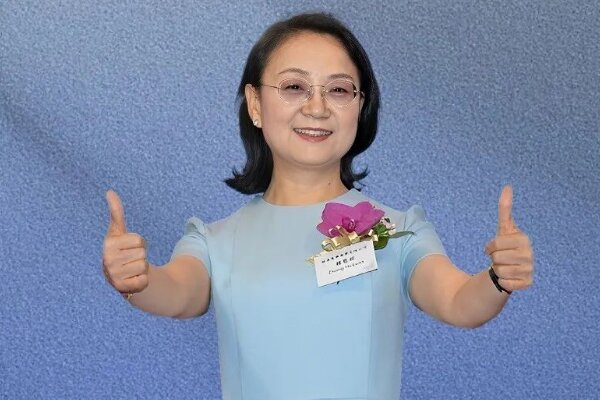
Zhong Huijuan is included in the "Vision" section not because of her wealth or market capitalization, but because she chose a path contrary to the mainstream of her time. In the 1990s, when China's pharma industry was dominated by generics, she devoted herself to innovative drug R&D—the most difficult and failure-prone path. This choice was not impulsive but based on a clear-eyed assessment of the industry's endgame: generics bring short-term profits, but innovation solves the "stuck-neck" problem. Her vision is reflected in her commitment to long-term value and her vigilance against shortcuts. Her archival value lies in proving that patience and resolve can drive real industrial transformation in a restless business environment.
Zhong Huijuan was born in 1961 in Lianyungang, Jiangsu, and graduated from Jiangsu Normal University with a degree in chemistry, working as a chemistry teacher in her early years. [1] In 1995, she resigned from teaching and joined Hansoh Pharmaceutical (predecessor of Hansoh Pharma), co-founded by her husband Sun Piaoyang, starting her entrepreneurial journey from scratch. [2] At that time, China's pharmaceutical industry was dominated by generics, while innovative drug R&D required huge investment, long cycles, and high risks. Zhong chose this difficult path. With a scientist's rigor, she devised a "generic-innovation hybrid" strategy: first establishing a foothold with high-end generics, building a quality system aligned with international standards, and channeling profits into innovative drug R&D. [3] Under her leadership, Hansoh gradually built R&D pipelines in oncology, CNS, anti-infection, and metabolic diseases, with multiple self-developed innovative drugs approved. [4] In 2019, Hansoh Pharma listed on the Hong Kong Stock Exchange, becoming an innovative pharmaceutical company with a global vision. [5]
Zhong Huijuan's business philosophy is centered on long-termism. In an industry chasing short-term returns, she insisted on focusing resources on innovative drug R&D, avoiding diversification and speculation. [3] She once said, "The R&D of innovative drugs is a long-distance race; patience and determination are more important than speed." [7] This philosophy is reflected in Hansoh's R&D investment: the company consistently allocates a high proportion of revenue to R&D, even under policy pressures such as volume-based procurement. [6] Zhong applies a chemistry teacher's rigor to R&D data and production processes, with an almost obsessive demand for quality. [3] She and her husband Sun Piaoyang independently operate Hansoh Pharma and Hengrui Medicine, forming a "dual giants" couple, but the two companies are independent and compete with product strength. [6] This strategic resolve has enabled Hansoh to maintain steady development amid industry cycles.
Zhong Huijuan's contribution lies not only in building a successful pharmaceutical company but also in driving the innovation transformation of China's pharmaceutical industry. In an era dominated by generics, she chose innovative drug R&D, setting a benchmark for long-termism. [3] Hansoh's self-developed drugs in oncology and other fields have broken the monopoly of overseas giants and improved the accessibility of domestic innovative drugs. [4] After the 2019 listing, Zhong briefly became the world's richest self-made woman, inspiring more women to pursue entrepreneurship. [5] [6] The "dual giants" couple with Sun Piaoyang has become a unique landscape in China's pharma industry, demonstrating the possibility of independent operation and collaborative competition. [6] Zhong's story has been widely reported as a model of "the hard road makes creators." [3] Her archival value lies in proving that patience and resolve can create long-term value in a restless business environment.
Zhong Huijuan has spent thirty years proving that shortcuts make merchants, while the hard road makes creators. The business proposition she leaves behind is: how can companies adhere to long-termism under the pressure of capital and time? Her significance lies in providing a replicable model for China's pharma industry transformation: starting with a generic-innovation hybrid and gradually moving toward independent innovation. Her story reminds us that true vision is not about chasing trends but about timing the inflection point and investing persistently in the right direction.