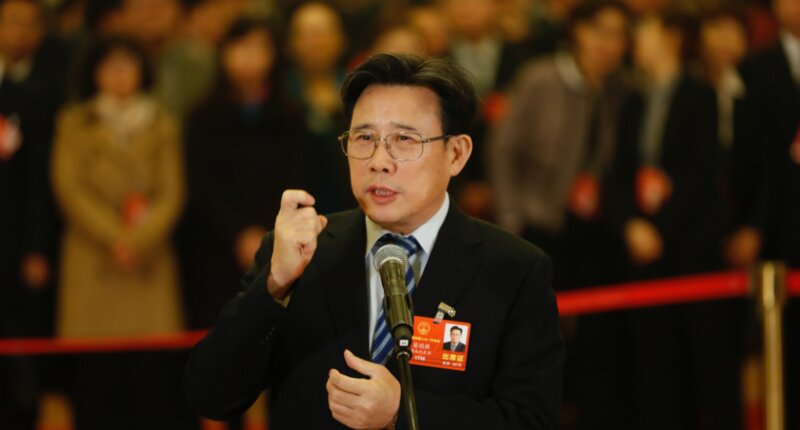
Businesses must be responsible, and serving the country through industry is not an empty talk.
In an era when the pursuit of 'fast money' and 'light assets' has become consensus, Liang Wengen spent forty years doing the most 'heavy' proof: using the youth of a generation to fill the dignity of a country's industry. He voluntarily jumped off the 'iron rice bowl', poured 60,000 yuan of savings into a rural workshop, started with welding materials, and eventually built SANY into a global first-tier heavy industry enterprise. His trajectory is not a wealth myth, but a fable about 'heaviness': in an era that values 'lightness' and 'quick success', the heaviest, slowest, and most stubborn persistence constitutes the most indispensable ballast for a country's industrial base. Liang Wengen is included in the 'Pattern' section because he proved that true 'stability' is not adhering to the status quo, but anchoring an ambitious goal and making bets throughout one's life.
Liang Wengen was born in Lianyuan, Hunan in 1956. He graduated from Central South Institute of Mining and Metallurgy in 1983 with a degree in metal materials and was assigned to Hongyuan Machinery Factory under the Ministry of Ordnance Industry. [1] In 1986, he gave up his 'iron rice bowl' and, with three partners, scraped together 60,000 yuan to start a welding materials factory in Maotang, Lianyuan. [1] [2] Early attempts at various products failed, but they eventually succeeded by focusing on welding materials through repeated debugging. [2] In 1993, the company was renamed SANY Group, moved its headquarters to Changsha, and decided to enter construction machinery. [1] [2] In 2003, SANY Heavy Industry listed on the Shanghai Stock Exchange, becoming the first private construction machinery company to go public. [3] Subsequently, SANY continued to break through in concrete machinery, acquiring German Putzmeister in 2009 to accelerate internationalization. [5] In 2011, Liang Wengen became China's richest man with a net worth of 59.4 billion yuan. [4] In 2022, he resigned as chairman of SANY Heavy Industry, succeeded by Xiang Wenbo, but remained chairman of SANY Group. [6]
Liang Wengen's business philosophy centers on 'independent innovation' and 'long-termism'. Facing foreign technology blockades, he chose independent R&D rather than market-for-technology or OEM. [2] He led the team to start with concrete pump trucks, tackling component by component, ultimately achieving breakthroughs in domestic heavy equipment. [2] SANY Heavy Industry has long been the world's No.1 in concrete machinery, with products exported to over 150 countries. [7] Liang once said: 'Businesses must be responsible, and serving the country through industry is not an empty talk.' [8] He insisted on reinvesting profits into R&D and manufacturing, avoiding financial speculation, and focusing on one track for life. [2]
Liang Wengen turned a rural workshop into a global first-tier heavy industry enterprise, filling the gap in China's construction machinery industry. [2] His success inspired countless Chinese entrepreneurs, proving that the path of serving the country through industry is viable. [8] SANY's products have played an important role in 'Belt and Road' projects and global emergency rescue, enhancing the international image of 'Made in China'. [2] Liang chose to hand over the reins at the peak of his career, demonstrating a pattern of retiring after success. [2] His story has been widely reported and has become a model of long-termism. [1] [2]
The business proposition Liang Wengen leaves behind is: under technological blockade and market pressure, how can Chinese enterprises achieve industrial breakthrough through independent innovation? He gave the answer in forty years—there is no shortcut, only saturated investment and long-termism. His exit is equally enlightening: retiring after success, not clinging to power, and handing over the enterprise to the next generation. His story challenges everyone in the tide: when all resources reward 'smart' shortcuts, do we still believe in and are willing to walk through that 'heavy' narrow gate?