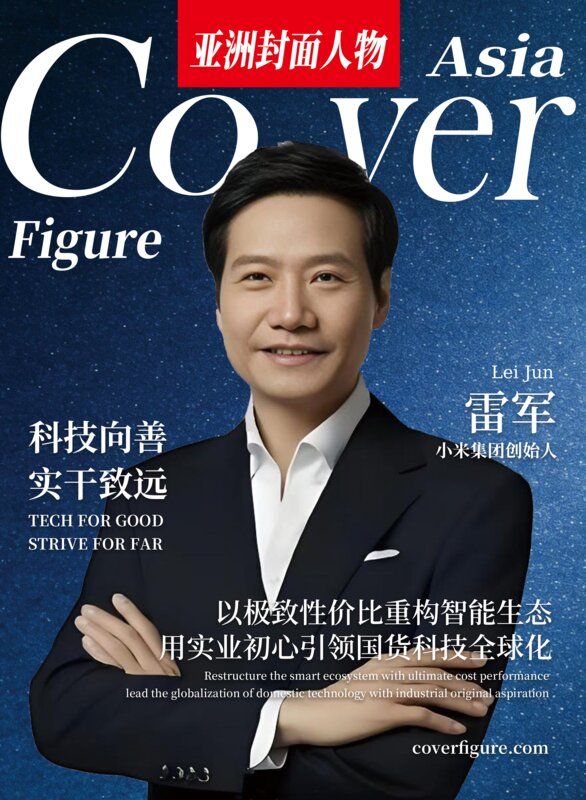
Even a pig can fly while standing in the wind. But I want to be the one who creates the wind.
Lei Jun is a rare serial entrepreneur in Chinese business history — not a prodigy, but someone who, through thirty-four years of relentless running, forged himself from programmer to general manager, from investor to phone maker, to automotive disruptor. He embodies a particular commercial species: not one who bets on the wind, but one who repeatedly proved he can create it. His selection for the Cover Story column of Asia Cover Figure is not merely because Xiaomi entered the Fortune Global 500, but because he represents a distinctly Chinese path of industrial evolution — from software to hardware, from phones to cars, from ecosystem to full-spectrum ecosystem. Each crossing was not speculation but a redefinition of industrial depth. This archive documents one man's relationship with three eras.
Lei Jun's career spans three eras of China's technology industry — software, the internet and smart hardware. He joined Kingsoft in 1992 as its sixth employee, rising from programmer to general manager and chairman across sixteen years of work on products such as WPS, and led Kingsoft's listing on the Hong Kong Stock Exchange in 2007 [4] [5]. In between, he founded the e-commerce site Joyo.com in 2000, later acquired by Amazon [5]. After Kingsoft's listing he turned to angel investing, backing companies such as YY and UCWeb. In April 2010 he co-founded Xiaomi with Lin Bin and other partners, entering through the MIUI operating system and affordable smartphones, and reshaped China's handset industry with the “triathlon” model of software, hardware and internet services [2] [6]. Xiaomi listed on the HKEX Main Board in 2018 (1810.HK). In 2021 he set out again, announcing that Xiaomi would build electric cars as a wholly owned business — taking the company into a new phase of smartphones, vehicles and AI together [2].
In smartphones, Xiaomi has ranked among the world's top three makers by shipments for five consecutive years, with a market share of about 13.3% in 2025 and global monthly active users reaching 754 million in December 2025, according to Omdia data cited in the company's annual results [1]. Xiaomi first entered the Fortune Global 500 in 2019 and has climbed the ranking since. Smart electric vehicles became his second growth curve: in 2025 the SU7 outsold the Tesla Model 3 in China with roughly 258,164 units (according to the China Passenger Car Association) to become the best-selling pure-electric sedan in the segment above RMB 200,000. For the full year Xiaomi delivered 411,082 vehicles; revenue from smart EVs, AI and other new businesses reached RMB 106.1 billion, and the segment posted positive operating income for the first time [3] [1]. In public life he is a National People's Congress deputy and vice chairman of the All-China Federation of Industry and Commerce, speaking regularly on the private sector and innovation [7]. He and Xiaomi also support education and public-welfare causes.
Xiaomi's product universe began with the MIUI operating system and the numbered Mi phone series, whose near-cost pricing and online community defined the Chinese internet-phone model. The Mijia ecosystem then extended that approach to hundreds of smart devices — air purifiers, wearables, televisions, robot vacuums — building one of the world's largest consumer AIoT platforms [5]. In vehicles, the SU7 sedan launched in 2024 as the first model; the high-performance SU7 Ultra followed in February 2025, with the production car setting a Nürburgring Nordschleife lap record of 6:22.091 for a four-door production car [3]. The YU7 SUV, launched in June 2025, drew more than 289,000 firm orders in its first hour according to the company [3]. The all-new SU7 arrived in March 2026 with LiDAR and an Nvidia Thor chip across the range; by August the SU7 series had passed 500,000 deliveries, the extended-range SkyNomad (Pengcheng) series opened for pre-order, and Xiaomi confirmed plans to take its cars to Europe in 2027 [3] [1].
The core proposition Lei Jun leaves for Chinese business is not any single product or success, but the very capacity for continuous transformation. Over thirty-four years he demonstrated that an entrepreneur can cross four entirely different industrial cycles — software, internet, hardware, automobiles — learning from scratch each time, rebuilding cognitive frameworks, finding new industrial rhythms. This capacity is extraordinarily rare in China today, where most entrepreneurs owe their success to a single bet or a particular era's dividend. Lei Jun's value lies in showing how evolution remains possible even after the dividends fade.