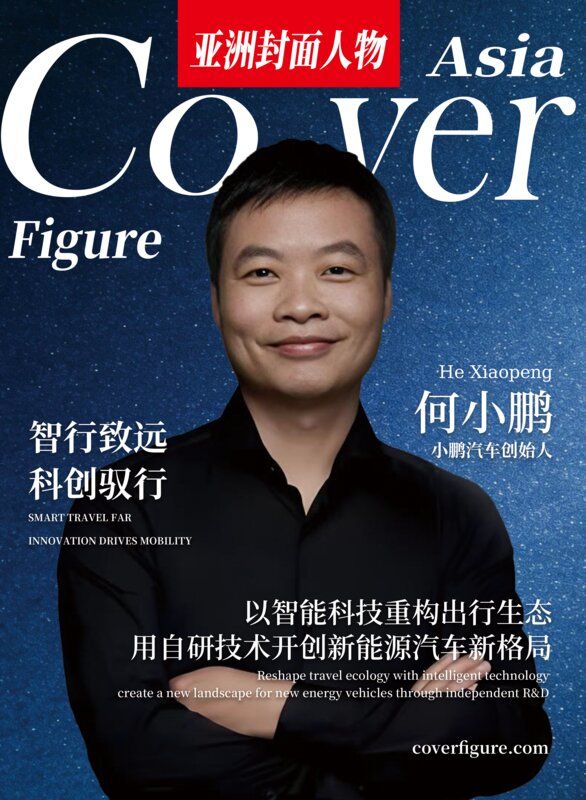
Building a car is a marathon, not a sprint. You have to be able to endure loneliness.
He Xiaopeng is included in the 'Vision' section not because he is the most successful founder among new EV startups, but because in two industrial transitions, he chose the more difficult, slower, yet more long-term valuable path. From UC to XPeng, from internet to manufacturing, he always entered before the inflection point of technology cycles, countering industry impatience with full-stack self-development. His archival value lies in: why would an already successful internet entrepreneur be willing to abandon glory and enter the asset-heavy, long-cycle auto industry? How did he establish technological faith with the decision to 'burn 400 million without compromise'? This courage to step out of the comfort zone and adherence to long-termism are the core propositions of the 'Vision' column.
He Xiaopeng's entrepreneurial career began with the mobile internet wave. In 2004, he co-founded UC Youshi with Liang Jie, launching UC Browser. With advantages such as data saving and fast speed, UC Browser quickly accumulated hundreds of millions of users, becoming a national-level app during the transition from feature phones to smartphones. In 2014, UC was acquired by Alibaba, and He Xiaopeng served as president of Alibaba Mobile Business Group, completing a brief transition from entrepreneur to professional manager. However, he did not stay in his comfort zone; instead, he keenly perceived the opportunity in the smart EV industry and founded XPeng Motors the same year. From internet to manufacturing, from asset-light to asset-heavy, He's second venture faced entirely different challenges. He led the team to build the R&D system from scratch, and in 2017 made the decision to scrap the first batch of prototypes, incurring a loss of over RMB 400 million, thereby establishing the gene of 'technology first, quality foremost'. Since then, XPeng has continued to invest heavily in intelligent driving and smart cockpit, with cumulative R&D investment exceeding RMB 19.4 billion by 2025, and achieved dual listing on the NYSE and HKEX.
He Xiaopeng's business philosophy centers on 'full-stack self-development' and 'long-termism'. He firmly believes that the core competitiveness of smart EVs lies in technology, which must be controlled in-house. Therefore, XPeng insists on self-development in intelligent driving, smart cockpit, and electrification platforms, launching key technologies such as XNGP full-scenario intelligent assisted driving, full-scenario voice interaction, and 800V high-voltage SiC platform. While the industry generally pursues short-term sales and cost control, He chooses to invest heavily in R&D, even under financial pressure. The decision to scrap the first batch of prototypes in 2017 is a manifestation of this philosophy. He once said publicly: 'Building a car is a marathon, not a sprint. You have to be able to endure loneliness.' This long-termism also extends to frontier technologies such as humanoid robots and flying cars, positioning XPeng as an 'embodied AI tech company' rather than a mere automaker.
He Xiaopeng's influence extends beyond XPeng itself, driving technological progress and globalization in China's smart EV industry. The partnership with Volkswagen enabled the export of core technologies such as Turing AI chip and VLA model, marking a shift from 'market for technology' to 'technology going global'. In 2025, XPeng's deliveries hit a record high, validating its technology strategy. He's cross-industry entrepreneurial experience provides a model for internet entrepreneurs entering hard tech. His adherence to long-termism and strategic focus amid industry fluctuations has made him a representative figure of China's tech innovation. The industry praises him for 'defining China's smart mobility with extreme self-development', and his vision lies in daring to choose the difficult but correct path.
The business proposition He Xiaopeng leaves behind is: in technology-driven industrial transformation, how can long-termism balance with commercial reality? He proved through two ventures that true vision is not about overlooking from a height, but daring to choose the difficult and correct path at critical moments. From scrapping the first batch of prototypes to investing RMB 19.4 billion in R&D, from partnering with Volkswagen to deploying humanoid robots and flying cars, He is constantly expanding the boundaries of smart mobility. His archival value lies in how an entrepreneur embeds personal choices into the logic of the times, traverses cycles with technological faith, and ultimately defines the future of China's smart mobility.