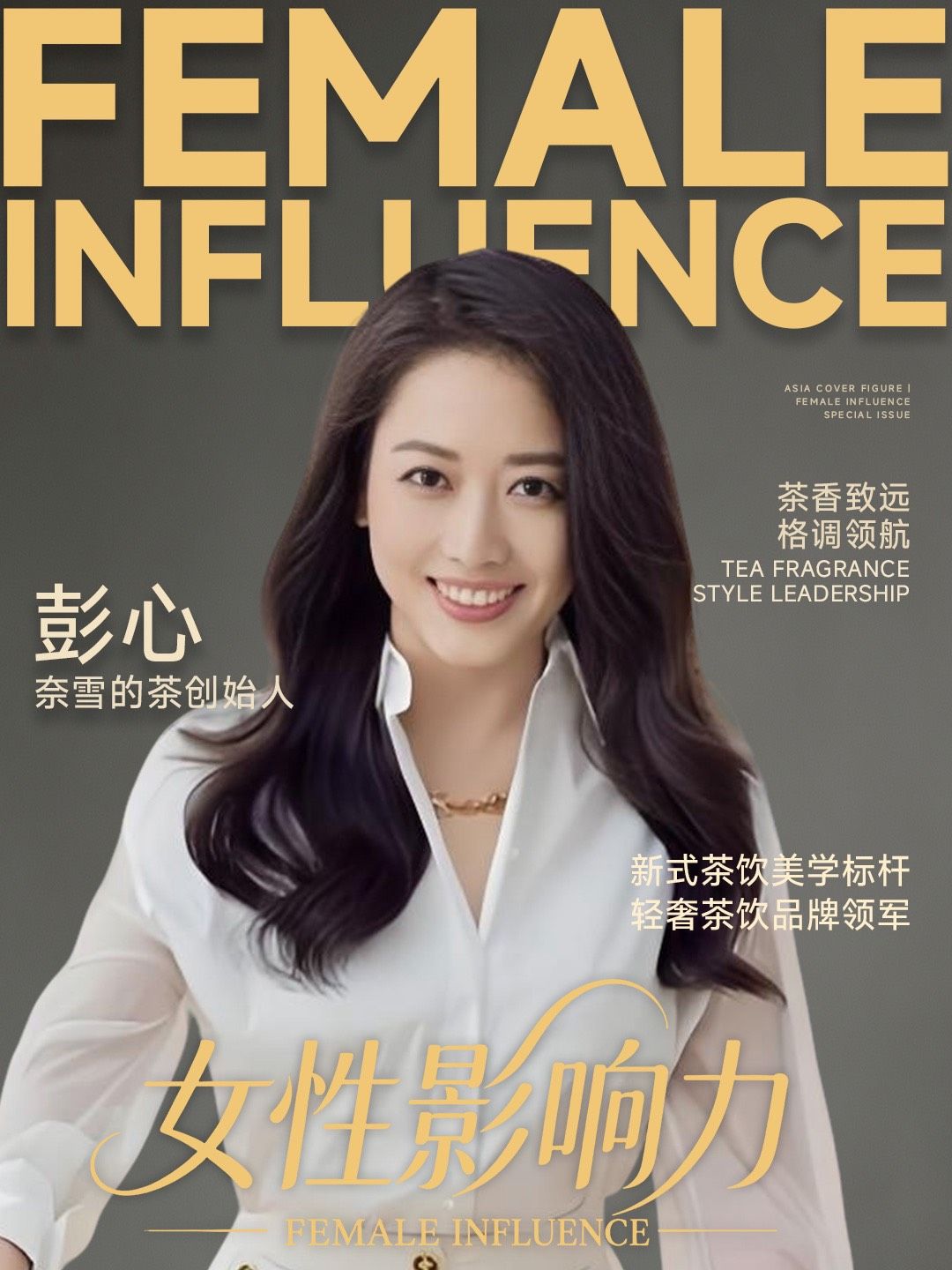
Making a good cup of tea is the greatest respect for consumers.
Peng Xin is included in the 'Women's Influence' column not only because she founded Nayuki and led it to listing, but also because she redefined the aesthetics and experience of China's new tea with feminine delicacy and resilience. In a consumer entrepreneurship field traditionally dominated by men, she built a brand empire combining quality and beauty with the simple philosophy of 'making tea with heart.' Her archival value lies in that her experience reflects the possibilities for female entrepreneurs in the consumer sector, as she created commercially valuable influence with era significance through extreme pursuit of product, space, and brand. Her story is a microcosm of the rise of female power on China's business stage and a model of female leadership in the new consumption era.
Before founding Nayuki, Peng Xin was a corporate white-collar worker but had a deep passion for tea. Around 2015, China's tea market was undergoing consumption upgrading; traditional milk tea shops suffered from weak branding, low standardization, and monotonous experience, while new-generation consumers demanded higher quality, visual appeal, and spatial experience. Peng Xin keenly identified the market gap and founded Nayuki in Shenzhen in 2015, with the brand name derived from her online name 'Nayuki,' symbolizing 'making tea with heart.' From the first store, she established a product direction based on premium tea leaves, fresh fruits, and creative recipes, with emphasis on spatial experience. Nayuki was among the first to launch the 'fresh fruit tea' category, insisting on fresh-cut fruits, driving the industry's upgrade from the 'milk tea era' to the 'fresh fruit tea era.' Simultaneously, she innovatively introduced the 'tea + soft European bread' composite format, enriching consumption scenarios, increasing average order value and customer dwell time, a model later widely adopted by the industry. [1]
Peng Xin's business philosophy centers on 'making tea with heart,' positioning Nayuki as a lifestyle brand rather than a mere tea shop. She pioneered the 'third space' concept in the new tea industry, with store designs featuring bright, transparent styles incorporating glass, metal, and greenery; some flagship stores include reading and social areas to cater to different scenarios. She hopes Nayuki can define Chinese youth's tea culture just as Starbucks defined coffee culture, hence insisting on a direct-operated model, focusing on single-store quality and brand tone, and avoiding low-price franchising and rapid expansion. In June 2021, Nayuki listed on the Hong Kong Stock Exchange, becoming the 'first new tea stock,' a milestone in industry capitalization. After listing, facing intensified competition and changing consumption environments, Peng Xin led the team in advancing digitalization, including mini-program ordering, membership systems, and private domain operations, while strengthening supply chain upgrades to optimize cost structures. She has repeatedly stated that she will not engage in low-price involution, insisting on letting quality and experience speak, a steadfastness particularly valuable in the fiercely competitive market. [1] [2] [3]
Peng Xin's impact on China's new tea industry is profound. She not only built a listed brand but also drove the industry's upgrade from street-side milk tea shops to branded, quality-focused establishments. Nayuki's 'fresh fruit tea' category and 'tea + soft European bread' model have been widely adopted, becoming industry standards. Her advocacy of the 'third space' experience enhanced the social attributes of tea shops, changing consumer perceptions. As a female entrepreneur, Peng Xin demonstrates delicacy and resilience, with her extreme pursuit of product quality and control over brand tone bearing a distinct personal imprint. She fosters an open and inclusive corporate culture, encouraging team innovation. Amid fierce industry competition, she remains sober, not chasing short-term traffic, but insisting on long-term value. Peng Xin's success proves that in an ordinary consumer track, making products, experiences, and brands with heart can create commercially valuable influence with era significance. Her story inspires many female entrepreneurs and serves as a model of female power in China's consumer sector. [1] [3]
The business proposition Peng Xin leaves behind is: in the wave of consumption upgrading, how to counter short-term temptations with long-termism and build brand barriers with quality and aesthetics. She proved that even in a seemingly homogeneous track, insisting on product power, spatial experience, and brand tone can win dual recognition from capital and consumers. Her brand practice has influenced the industry's aesthetics and values. For future entrepreneurs, Peng Xin's archive reminds us that true commercial influence lies not in the speed of scale expansion, but in the adherence to value and the persistence of aesthetics.