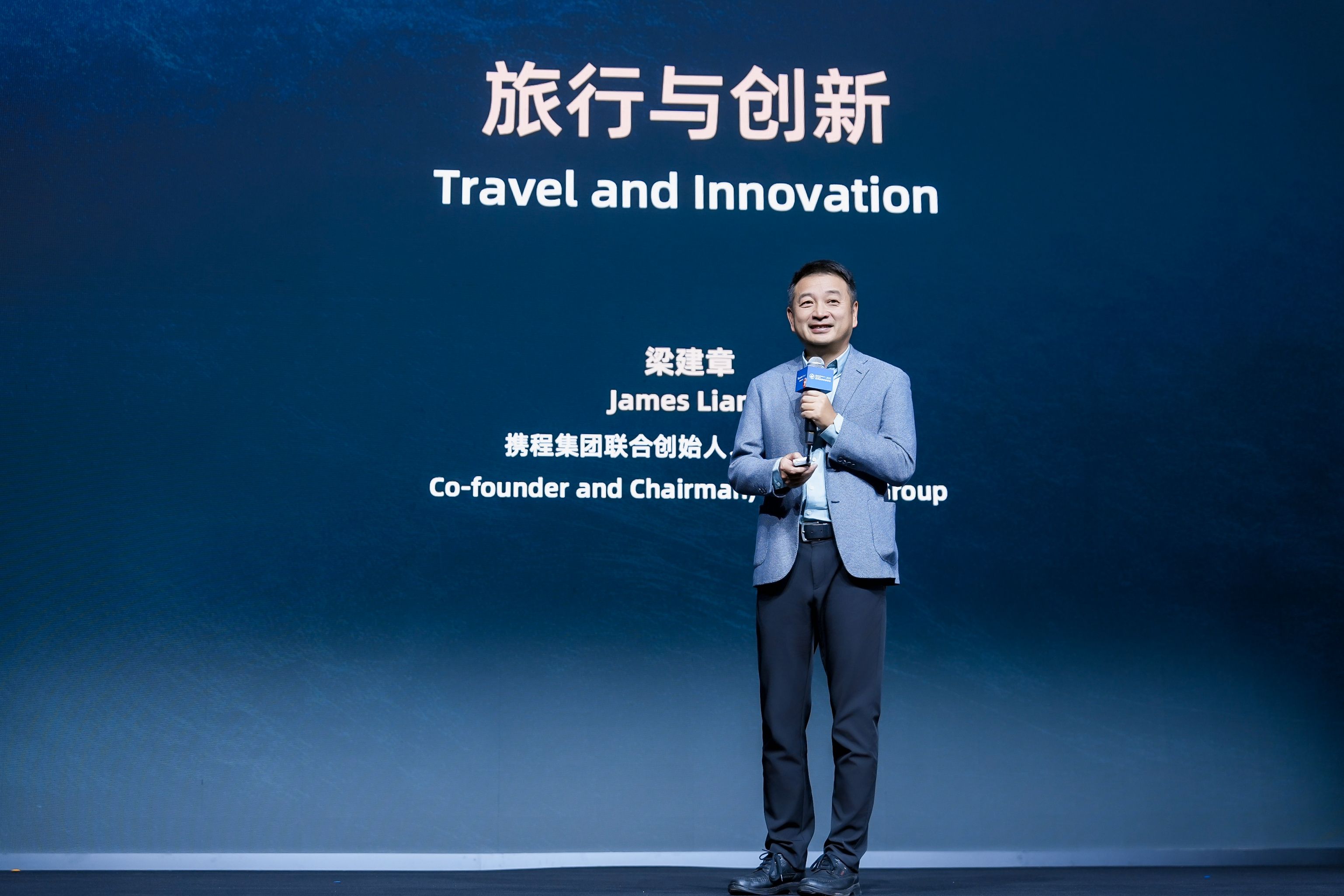
The downturn in the travel industry will eventually pass, and survival is victory.
Liang Jianzhang is included in the 'Business Rebel' column not only for leading Ctrip through the pandemic's darkest hours but also for his two voluntary retirements and returns, shifting between business and public issues. His rebellion is not risk-taking but based on long-term observation of industry cycles and population structure. When the 31 billion yuan cancellation wave hit, he chose not to shrink but to personally go live, stabilizing user trust through responsibility. This choice to prioritize responsibility over profit in crisis is the archival value this column seeks to preserve.
Liang Jianzhang was born in Shanghai in 1969. A child prodigy in computer science, he developed programs at 13, entered Fudan University's gifted youth class at 15, and later earned a master's degree in computer science from Georgia Tech. In 1999, he returned to China to found Ctrip, entering the online travel market with standardized, refined services. Leveraging deep insights into the internet and tourism, Ctrip rose rapidly and listed on Nasdaq in 2003, becoming the first Chinese OTA to go public [1]. Through mergers and acquisitions, Ctrip maintained its leadership, covering accommodation, transport, vacation, and business travel. At the peak of his career, Liang twice stepped back to pursue a PhD in population economics, transforming into a demographer focused on China's population structure [6].
In early 2020, COVID-19 struck, halting tourism. As the industry leader, Ctrip bore the brunt, with platform-wide cancellations reaching 31 billion yuan and call volumes surging dozens of times; 15,000 customer service staff worked overtime continuously [3]. To protect users, Ctrip activated a 200 million yuan disaster relief fund and absorbed refund losses, including 1.2 billion in subsidies in Q1 alone, leading to a net loss of 5.4 billion yuan and a 42% revenue decline [2]. Liang and CEO Jane Sun took zero salary, and executives took half salaries to stabilize the team. Meanwhile, Liang shed his scholar identity to personally host live-streaming sales, visiting 31 cities in 2 months and completing 11 broadcasts, dressing as Tang Bohu, Qin Shi Huang, and other historical figures, generating nearly 400 million yuan in sales and selling 520,000 room nights for over 230 high-end hotels [4]. He insisted on personally experiencing every product, losing weight after intense sessions but remaining energetic.
During the three-year pandemic, Ctrip avoided mass layoffs, controlling costs through zero executive salaries and performance optimization, while launching the 'Travel Revival Plan V' to boost industry confidence. Liang firmly believed that 'travel is a basic need; recovery will be delayed, not absent' [5]. In 2023, the market recovered and Ctrip rebounded; in 2024, net profit reached 17.2 billion yuan, up 72% [5]. Liang proved through action that a company's value in crisis comes first from shouldering responsibility. He is not only a business operator but also an observer of public issues, long advocating for relaxed fertility policies, embodying dual roles as entrepreneur and scholar. His rebellion redefines the essence of a business rebel: shouldering burdens in downturns and taking responsibility in crises.
Liang Jianzhang leaves a business proposition: an entrepreneur's duty is not perpetual victory but crossing cycles. Through shouldering 31 billion in cancellations and 11 live broadcasts, he proved that in the darkest moments, trust is more valuable than profit. His transformation from entrepreneur to demographer reminds us of the long-term care for society beyond business success. His archival value lies in how an industry pioneer redefined responsibility in crisis and left his answer to the era's questions.