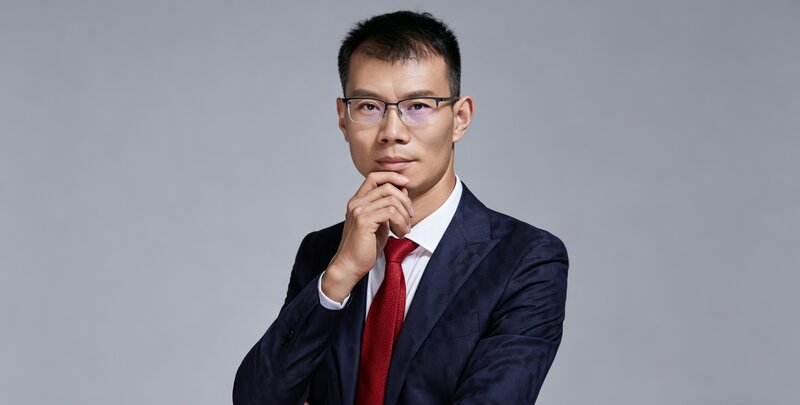
To do catering is to be conscientious, and food safety is the bottom line and lifeline.
Zhang Hongchao is included in the 'Vision' section not because he built a huge commercial empire, but because he chose a path opposite to the industry mainstream. While new tea brands competed for premium pricing, traffic-driven narratives, and capital extravagance, he treated affordability as a belief and public welfare as his foundation, spending 27 years turning an affordable cup of tea into the world's largest chain. His vision is reflected in his insistence on 'slowness': building his own supply chain, not following trends, and not expanding blindly. These seemingly 'too slow' actions ultimately built an unassailable moat. The archival value of his story lies in documenting a success based on industrial rationality and long-termism, rather than opportunism.
Zhang Hongchao was born in 1978 in a rural family in Shangqiu, Henan. He left school early and worked various odd jobs. In 1997, at age 19, he used 3,000 yuan saved by his grandmother to set up a shaved ice stall in a Zhengzhou urban village, named 'Cold Current Shaved Ice.' The early days were extremely difficult; the stall was relocated several times, and he once pedaled a tricycle for miles to save on delivery fees. In 2000, the shop was renamed 'Mixue Bingcheng,' formally entering the fresh beverage industry. In 2005, he launched a 1-yuan ice cream, which quickly opened the market with its extreme cost-performance ratio, establishing the 'high-quality, affordable' positioning. In 2007, his younger brother Zhang Hongfu joined, and the two brothers collaborated with a clear division of labor, driving the brand from regional to national. Starting in 2012, Zhang Hongchao began building his own supply chain, from raw material cultivation, production and processing to warehousing and logistics, gradually achieving full-chain self-control. This decision laid a solid foundation for Mixue's long-term affordable pricing strategy. In 2025, Mixue listed on the Hong Kong Stock Exchange, with a market value exceeding HK$100 billion and over 60,000 stores globally, becoming the largest fresh beverage chain by store count. [1] [2] [3] [4] [5] [6] [8]
Zhang Hongchao's business philosophy centers on 'high quality at affordable prices' and 'long-termism.' He believes the core value of a drink is good taste, safety, and substance, not packaging or concepts. He insists on not following trends or blindly raising prices, but achieving affordability through extreme cost control. Building his own supply chain was the key battle in this strategy. Starting in 2012, he invested heavily in building an independent supply chain, covering raw material cultivation, production and processing, warehousing, and logistics. Although this decision required large investment and a long cycle, it effectively reduced raw material costs and ensured stable quality, allowing products like 4-yuan lemonade and 6-yuan pearl milk tea to remain unpriced for years. Zhang Hongchao calculates the big picture: even if the raw material cost per cup is reduced by just one mao, with annual sales of billions of cups, it represents a huge profit margin. He often says, 'To do catering is to be conscientious,' treating food safety as the bottom line. In management, since Mixue's headquarters revenue mainly comes from the supply chain, the supervision team focuses more on standardization and food safety than on pure sales figures. This management philosophy of 'keeping tens of thousands of stores clean and cheap for a decade' reflects his pragmatism and steadiness. [4] [6] [9]
Zhang Hongchao, over 27 years, turned a street-side shaved ice stall into the world's largest fresh beverage chain by store count. His success lies not only in commercial achievements but also in providing a viable path of 'high quality at affordable prices' for the industry. While many brands pursued premiumization and traffic-driven narratives, he insisted on serving the mass market, supporting long-term affordability through supply chain efficiency, and changing the industry's perception of the lower-tier market. Mixue's listing demonstrated that affordable tea can also support a market value of hundreds of billions, setting a benchmark for followers. Zhang Hongchao himself is low-key and pragmatic, rarely appearing in public, not building a personal IP, and focusing on products and supply chain. His story is seen as a model of 'long-termism,' proving that in a restless business environment, adhering to original intentions and extreme cost control can also win the market. His management philosophy and supply chain model have become important references for the new tea industry. [8] [9]
The business proposition Zhang Hongchao leaves behind is: in a business of extreme cost-performance, how to build a sustainable profit model through supply chain efficiency. Over 27 years, he proved that affordability does not mean low quality, but the ultimate in cost control. While the industry chased premiumization and traffic, he stuck to the mass market, achieving a market value of hundreds of billions through scale effects and supply chain moats. His significance lies in providing a replicable path for countless small and medium entrepreneurs: not relying on trends or capital, but on extreme cost calculation and long-term adherence to original intentions. This determination to 'keep doing one thing' is what this archive truly aims to preserve.